The AI Job Market Paradox: Record Layoffs, Record Vacancies
Here are two facts about the 2026 tech job market. Both are true. Put them next to each other and they stop making sense.
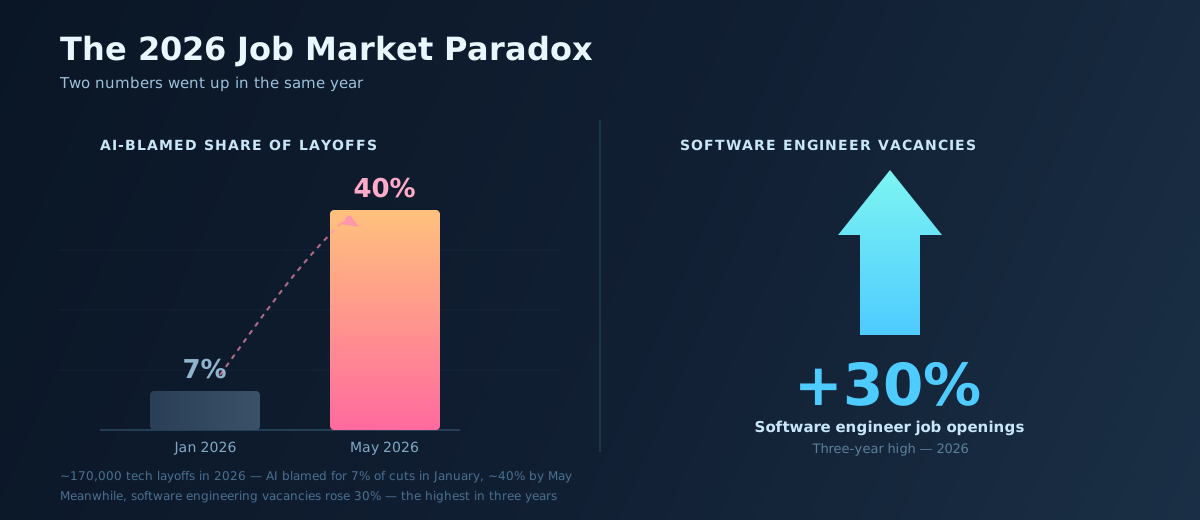
Fact one: tech companies have cut about 170,000 jobs this year. A growing share of those cuts get blamed on AI. In January, AI got blamed for about 7% of the layoffs. By May, that number had jumped to roughly 40%.
Fact two: software engineering job openings are up 30% this year. That's the highest they've been in three years.
So which is it? Is AI taking engineering jobs, or is it creating them? The honest answer is: both stories are true at the same time, and neither one, on its own, tells you what's really going on. Let's take them apart.
The Layoffs Are Real. The "AI Did It" Part Is Shakier.
Microsoft cut 23,000 jobs this year. UPS cut 32,000. Big, real numbers, at big, real companies. Nobody's disputing the layoffs happened.
What's worth questioning is the reason companies give for them.
Think about it this way: did AI actually get five times better at doing engineers' jobs between January and May? No serious researcher would say that. AI models improved during that stretch, sure. But not enough to explain a jump from "7% of layoffs" to "40% of layoffs" in four months.
Here's a simpler explanation, and it's the one a lot of skeptics have landed on: many companies hired too fast in 2021 through 2023. Now demand has cooled, and they need to cut staff back down. That's a normal, boring business cycle. But "we over-hired and now demand is soft" is not a story that impresses investors. "We are restructuring around AI" is. So AI becomes the headline, whether or not it's the real cause.
I think there's real truth to this. Not every "AI layoff" is really about a chatbot doing someone's job. Some of it is just old-fashioned over-hiring, wearing a new label because the new label sells better. I go deeper on this pattern — spending big and dressing it up as transformation — in The AI Bubble Isn't Popping, It's Leaking.
That said, some of the blame is real too. AI tools genuinely do make certain kinds of work faster. If a team can now do with 8 people what used to take 12, some companies will cut the 4. That part isn't a story. That's math.
Meanwhile, Companies Are Also Hiring Like Crazy
Here's where it gets confusing again.
While all these layoffs were happening, Marc Benioff at Salesforce announced plans to hire 1,000 new graduates, right in the middle of Salesforce's own AI-first messaging. That's not a company quietly ignoring AI. That's a company leaning into AI hard, and still deciding it needs more junior humans, not fewer.
And a Gartner survey found that 85% of customer service and support leaders are increasing the responsibilities given to human agents right now, not shrinking them. Support is one of the areas AI chatbots were supposed to take over first. Instead, most leaders are handing their human staff more to do, not less.
Put that together with the 30% jump in engineering job postings, and a pattern starts to show up. Companies aren't simply "replacing people with AI." They're reshuffling who they need, and for what.
The Real Story: The Jobs Didn't Disappear. They Moved.
Here's the piece I think most headlines miss.
The same efficiency push that gets used to justify layoffs is also the reason companies now need more engineers, not fewer. Someone has to build the AI-powered systems. Someone has to wire them into existing products. Someone has to catch the mistakes AI makes, because it still makes plenty. That work doesn't do itself, and it isn't going to a chatbot anytime soon.
So the demand for engineers didn't vanish. It shifted. Companies increasingly want engineers who know how to work with AI tools, not engineers doing the exact same job the exact same way it was done in 2022. That's a real skills shift, and it's one I've written about before in From Prompt Engineer to Agent Architect — the job title barely changed, but what the job actually requires changed a lot.
If you want a plainer way to say it: AI isn't shrinking the pie. It's changing who gets a slice.
The Part Nobody's Pricing In: Junior Hiring Is Quietly Collapsing
This is the part of the story I think matters most, and it's getting the least attention.
Talk to hiring managers and a pattern comes up again and again: companies that used to hire 10 junior engineers a year are now hiring 3. Not because junior engineers got worse. Because a lot of the small, repetitive tasks that used to be junior work — simple bug fixes, small features, boilerplate code — can now be handled faster with AI help, by someone more senior directing it.
That sounds efficient. Short term, it is. Long term, it's a problem nobody's really budgeting for.
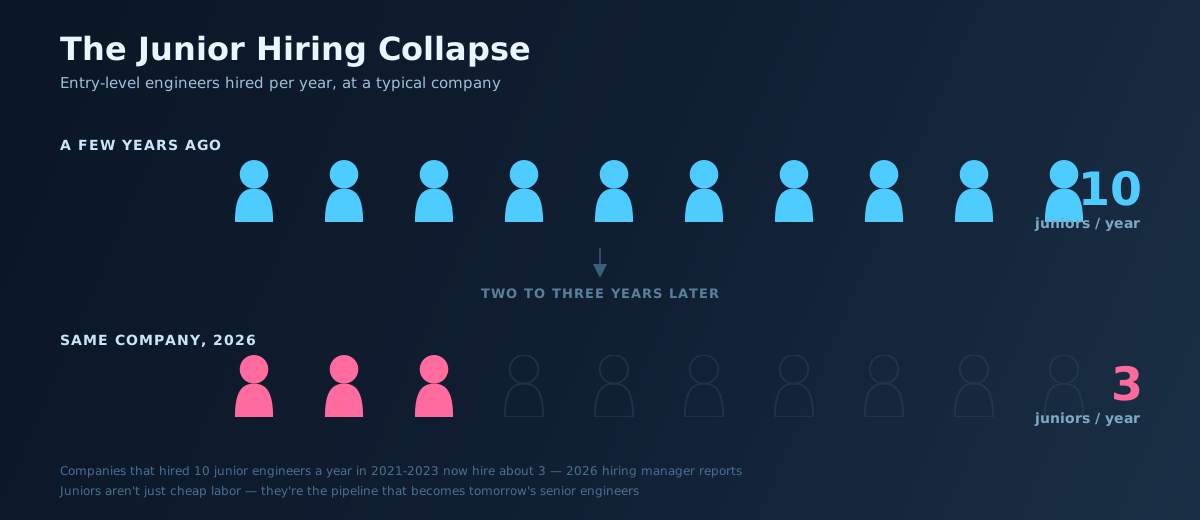
Junior engineers were never just cheap labor. They were the pipeline. The people who spend two or three years fixing small bugs and shipping small features are the same people who become the senior engineers companies desperately need five or ten years later. If that pipeline shrinks now, quietly, while everyone's busy debating whether AI "took the jobs," we're going to feel the shortage later — right when it's much harder to fix. You can't hire your way out of a missing generation of engineers in six months. It takes years to grow one.
That's the real casualty of this moment. Not senior engineers. Not the overall job count, which is actually growing. The junior on-ramp — quietly narrowing while both louder headlines argue past each other.
Key Takeaways
- Both headlines are true: ~170,000 tech layoffs in 2026, AI blamed for a rising share (7% in January, ~40% by May) — while software engineering job postings are up 30%, a three-year high.
- A lot of "AI did it" layoff framing is a convenient investor narrative. "We're restructuring around AI" sounds better than "we over-hired and demand cooled," even when the second one is closer to the truth.
- Some of the blame is genuine — AI tools really do let smaller teams do more, and that shows up in real headcount cuts.
- Demand for engineers isn't disappearing, it's shifting toward people who can build, direct, and supervise AI-powered systems.
- The quiet, under-discussed casualty is entry-level hiring: companies that used to hire 10 junior engineers a year now hire 3. That's a pipeline problem that won't show up as a crisis for years — by which point it will be very hard to fix.
Related Posts
- The AI Bubble Isn't Popping — It's Leaking — Why so much AI-era corporate messaging is a narrative dressed up for investors, and why that's actually not the worst outcome.
- From Prompt Engineer to Agent Architect — The engineering job title barely changed in the last two years. What the job actually requires changed enormously.
- The Skeptic's Reality Check: What AI Is Actually Delivering in 2026 — Where AI is genuinely moving the needle on productivity, and where the numbers say it just isn't yet.
- The Agent Leap: Why 73% of Workplaces Now Run AI Agents — The gap between companies that have adopted an AI agent and companies actually getting value from one.
If you're a junior engineer reading this and feeling nervous, here's my honest take: the door isn't closing, it's just narrower and it wants different things from you than it did three years ago. Learn to work with AI tools instead of around them, and go find teams doing work ambitious enough that AI alone can't do it. And if you're the one doing the hiring — think twice before you let this quarter's efficiency math quietly erase next decade's senior engineers. What are you seeing in your own hiring pipeline right now? I'd like to hear it.