The AI Bubble Isn't Popping — It's Leaking. And That's Better for Everyone
I have watched enough tech cycles to recognize the shape of this one.
The dot-com bubble didn't leak. It held pressure until it couldn't, then it detonated. Pets.com, Webvan, eToys — companies burning cash at a rate that required the internet to restructure human civilization in about 18 months to survive. When the assumption failed, there was nothing underneath to catch the fall. The pressure was narrative all the way down.
The AI situation in 2026 looks superficially similar — the valuation overshoot, the enterprise pilots that went nowhere, the demo-stage companies that raised $40M on a fine-tuned wrapper — but structurally it is different in one critical way. There is something real underneath. Not everywhere. Not proportional to the capital deployed. But it's there.
Code generation works. Customer support automation works. Search and retrieval are genuinely better. The models keep getting cheaper and more capable on a curve that, for once, hasn't flattened on schedule. That is not nothing. That is, in fact, the thing that separates a leak from a pop.
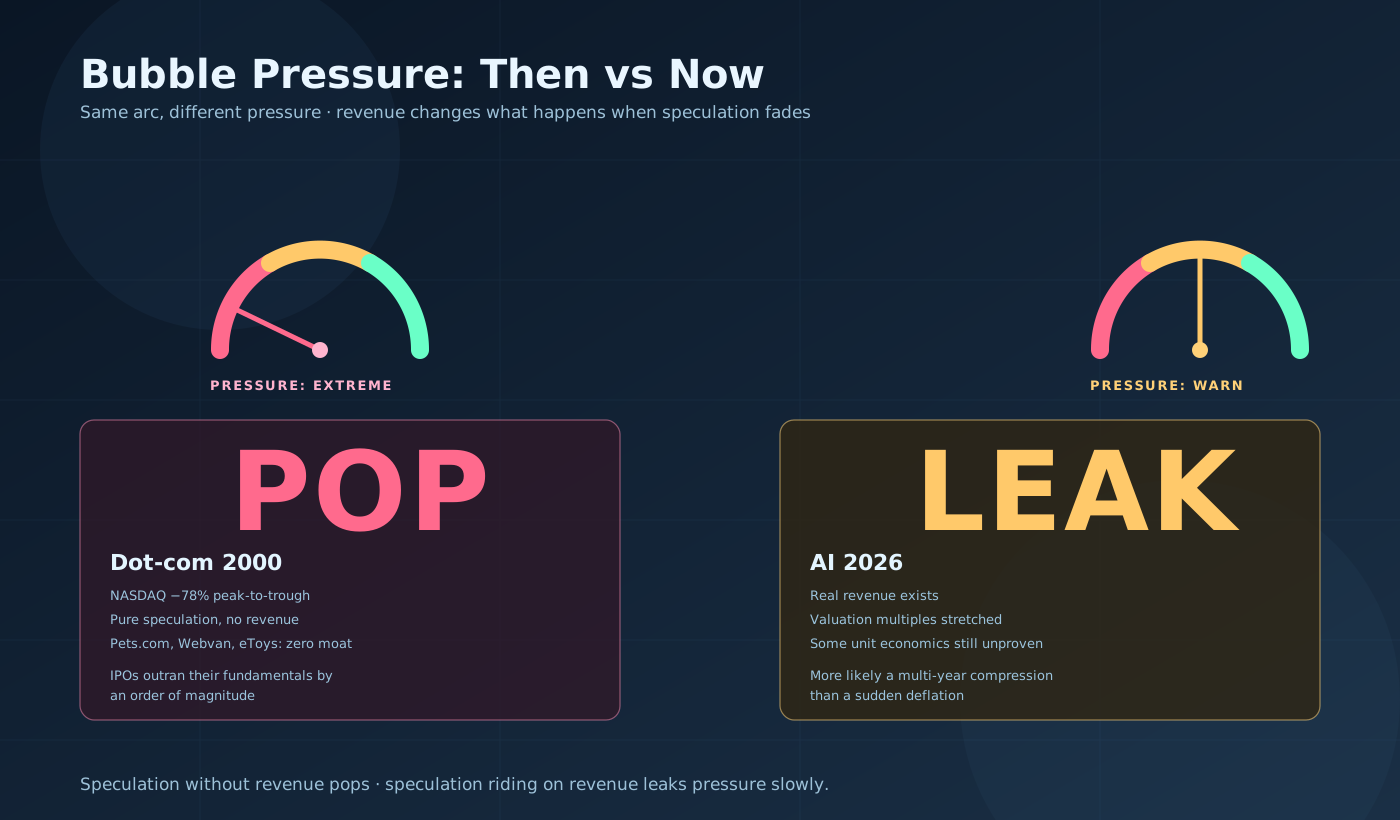 Two different failure modes. One is survivable.
What a Leak Actually Looks Like
A leaking bubble doesn't announce itself. It shows up in the quiet stats, the ones that don't make conference keynotes.
Enterprise pilot-to-production conversion rates tell the story without drama: in Q4 2024 it was around 8%. In Q1 2026 it's 12%. The direction is right. The pace is just slower than the pitch decks promised.
That four-point move is not a revolution. But it is a real market finding product-market fit at the unit level — pilots that survive contact with actual production infrastructure, real data, real edge cases, and still get funded for phase two. That is what normalization looks like from inside the numbers.
Meanwhile, the vaporware quietly disappears. No press release. No post-mortem. One day the company's website just stops updating.
The Uncomfortable Side of a Slow Leak
Here is what the optimistic framing skips: a pressure release still releases pressure. A lot of AI companies that raised on vibe rather than value are going to die quietly over the next 18 months. Not in a crash — in a slow bleed of runway, a series B that doesn't close, an acqui-hire that wasn't really an acquisition.
The ones that survive are the ones that can answer a simple question with real numbers.
# Vibe metric (what got you the Series A in 2023)
monthly_active_users = 50_000
"AI-powered" features shipped = 12

# Real metric (what keeps the lights on in 2026)
revenue_per_inference_call = $0.004
cost_per_inference_call    = $0.0018
gross_margin               = 55%   # defensible, scalable, real
The math above is not complicated. What's complicated is that most AI companies in 2023 and 2024 never ran it — because they didn't need to. Now they do.
Engineers who built things that work — production pipelines, systems with actual retrieval economics, agents that close support tickets — will be fine. The market for people who can ship AI that survives a production load is tighter than the hype cycle made it seem, and it's real.
Engineers who sold PowerPoints will have a harder year.
Normalization Is the Outcome You Actually Want
The alternative to a slow leak was a pop — and a pop would have set the whole field back five years. Regulatory overreach, capital drought, a decade of "AI winter 2.0" takes forming. We have seen that movie before, twice, and it is not good for anyone building in this space.
What a leak gives you instead is a forcing function. Infrastructure that was genuinely useful — the compute shifts, the algorithmic efficiency gains — stays. It gets cheaper. The use cases that demonstrated real ROI get more investment, more engineering attention, more time to mature.
The hype cools. The work continues. And the people still standing when the market clears are the ones who were building something, not just describing it.
That is not a disaster. That is how an industry grows up.
Key Takeaways
- A bubble pops when there is no value underneath the narrative. The AI bubble has real value underneath — just not proportional to where the capital went.
- Enterprise pilot-to-production conversion is rising slowly (8% to 12%), which is normalization, not collapse.
- The correction will be quiet: runway bleeds, rounds that don't close, acqui-hires. Not a crash.
- Engineers with production track records are fine. The market for working AI is real and growing.
- Normalization is the healthy outcome. The alternative — a hard pop — would have been far worse for the field.
Related Posts
- The Skeptic's Reality Check: What AI Is Actually Delivering in 2026
- DeepSeek Changed Everything
- Stop Fine-Tuning GPT-5. Use a 7B Model.
Seen this cycle before, or living through your first one? Drop a comment below — especially if your pilot-to-production numbers look different from the industry average.