Eighteen months ago, "Prompt Engineer" was a real job with a real skill set. Not a meme. Not a stepping stone. A discipline: system prompt construction, few-shot example curation, jailbreak surface hardening, chain-of-thought elicitation, output format control. People were good at it. Companies paid for it.
That job still exists. But it is no longer the ceiling.
Here is what the job description looked like then, and what the same role actually requires now.
The 2024 Job Description
Prompt Engineer Write and iterate on system prompts for LLM-powered features. Design few-shot examples to steer model output. Evaluate response quality. Own formatting instructions and output schemas. Collaborate with product to define acceptable model behavior. Red-team for jailbreaks and prompt injection.
Core skill: language craft. Knowing how to say the right thing to the model.
The 2026 Job Description
Agent Architect (same team, evolved scope) Design multi-step agent workflows with explicit failure boundaries. Own tool surface schema — what the agent can call, with what parameters, under what conditions. Define state checkpoints and recovery paths. Specify escalation conditions that trigger human review. Build eval pipelines with ground truth datasets and drift detection. Instrument agent runs for observability.
Core skill: systems thinking. Knowing what happens when something goes wrong three steps in.
The argument is in the diff.
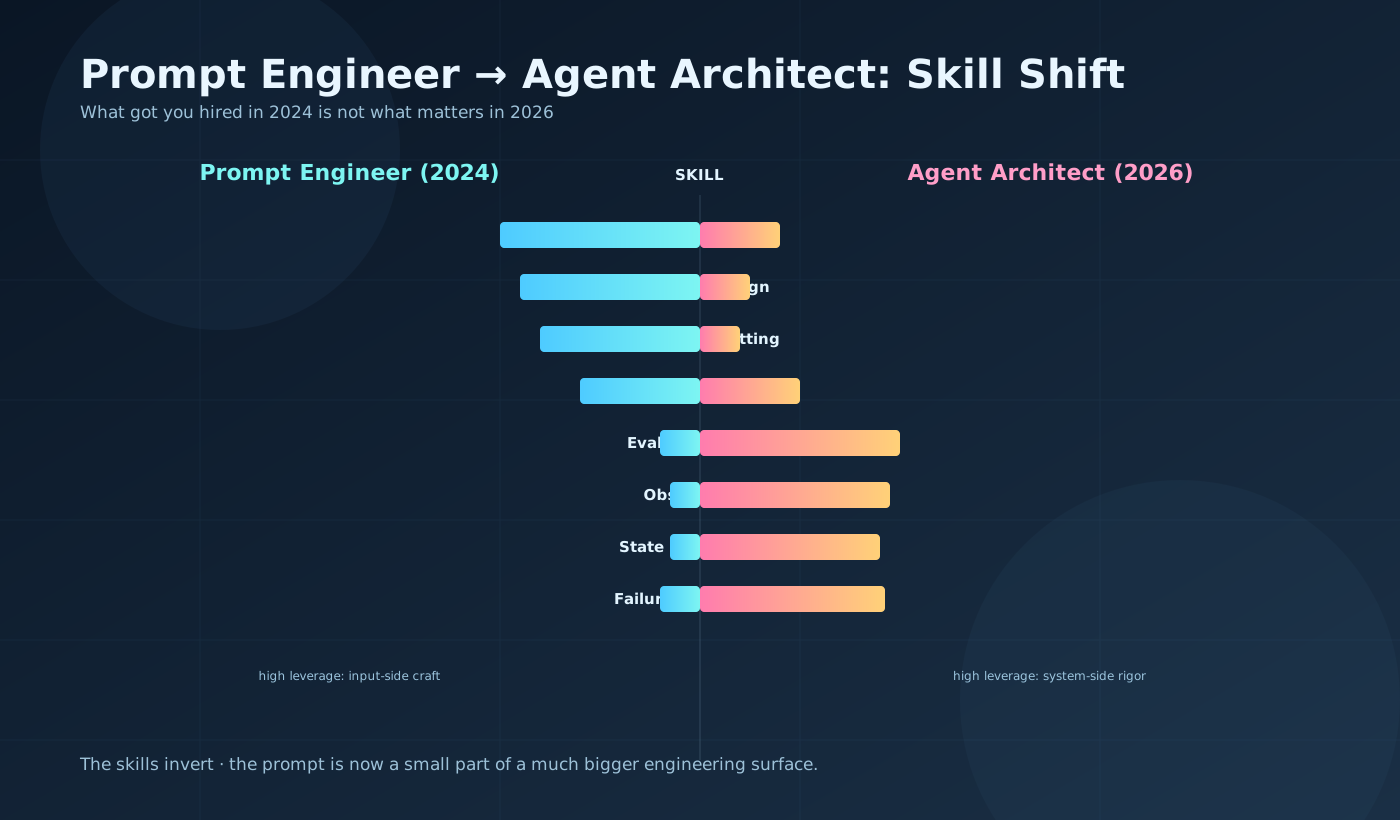
Same domain. Mostly different skills. The overlap is smaller than the job titles suggest.
What "Agent Architect" Actually Means
Four things that are not in the prompt engineering playbook at all.
Failure mode design. Not "how do I make this succeed" but "what is the blast radius when it fails?" An agent that calls an external API on step 4 needs idempotency guarantees on that call, because the chain might retry from step 2. You are not writing prompts. You are reasoning about distributed systems failure patterns applied to non-deterministic executors.
State machine thinking. The agent loop is a state machine with non-deterministic transitions. Which state do you persist to a checkpoint store? Which do you recompute? Where does a crash leave the system, and is that a safe resting state? Prompt engineers do not think about this because a single LLM call has no intermediate state.
Tool surface design. The MCP tool schema is a capability boundary. The design question is not "what should the agent be able to do?" It is "what should it be categorically unable to do?" Negative space. Write-access to a production database is a blast radius problem, not a permission problem. The tool surface is your primary safety control.
Eval architecture. "Does this look good" does not scale. You need ground truth — a dataset of inputs with known correct outputs or known correct behaviors. You need a measurement of drift from that ground truth over time. You need a threshold at which a human gets paged. That is an engineering system, not a vibe check.
The Concrete Diff
The same task — "summarize this support ticket and draft a reply" — solved two ways:
# 2024: Prompt Engineering solution
SYSTEM_PROMPT = """
You are a support agent. Given a customer ticket:
1. Summarize the issue in one sentence.
2. Draft a professional reply that acknowledges the issue,
   provides next steps, and closes warmly.
Output as JSON: {"summary": "...", "reply": "..."}
"""
# Ship it. If it fails, iterate the prompt.


# 2026: Agent Architecture solution
tools = [
    {
        "name": "fetch_ticket_history",
        "description": "Retrieve prior interactions for this customer ID.",
        # Scoped read-only. No write. Blast radius: zero.
    },
    {
        "name": "submit_draft_reply",
        "description": "Queue a reply for human review before sending.",
        # Idempotent. Drafts only. Human in the loop before send.
    },
]

checkpoints = ["ticket_loaded", "summary_generated", "draft_submitted"]
# If the agent crashes at draft_submitted, re-run is safe — idempotent tool.

escalation_condition = lambda state: (
    state.sentiment_score < -0.7          # High-anger ticket
    or state.ticket_age_days > 30         # Long-standing unresolved issue
    or state.customer_tier == "enterprise"# High-value account
)
# Escalation is explicit logic, not prompt instruction.
The prompt engineer owns the first block. The agent architect owns the second. Both are necessary. They are not the same skill.
The Actual Career Gap
This is not a "learn more AI" problem. Language craft and systems thinking are different cognitive modes. People who are excellent at the former are not automatically good at the latter. You can spend years getting better at prompts and make zero progress on blast radius analysis.
The people making this transition successfully are not the ones who learned more about models. They are the ones who started thinking about their agents the way a backend engineer thinks about a distributed system: what fails, when, with what consequences, and how do you contain it.
If you have not started thinking that way, the job description has already moved on without you. See how that plays out over a career, and specifically what the failure modes look like when agentic systems go wrong at the reliability level and the accountability level. For the infrastructure layer this runs on, the Terraform + MCP stack post is the practical next step.
Key Takeaways
- Prompt engineering was a real discipline. It is not the ceiling anymore.
- The agent architect role is defined by four skills absent from the prompt engineering toolkit: failure mode design, state machine thinking, tool surface design, and eval architecture.
- The career shift is not about knowing more AI. It is about switching from language craft to systems thinking.
- The two roles overlap, but less than the job titles imply.
Related Posts
- The Programmer Who Refused to Change
- Your AI Agent Just Got Fired
- Agent Reliability Blueprint
- Terraform + MCP: The AI Agents Infra Stack
Watched this transition happen on your team? I'd be curious whether it broke along the lines I described or differently — leave a comment.