The Skeptic's Reality Check: What AI Is Actually Delivering in 2026
The AI industry spent 2023 and 2024 promising transformation. In 2026, the invoice arrived.
Goldman Sachs published a finding in March that should have been bigger news than it was: at the economy-wide level, there is no meaningful relationship between AI adoption and productivity. Not a weak relationship. Not a delayed one. No relationship.
That is the honest starting point for any serious evaluation of where AI actually stands.
The Productivity Data Is Not What You Were Sold
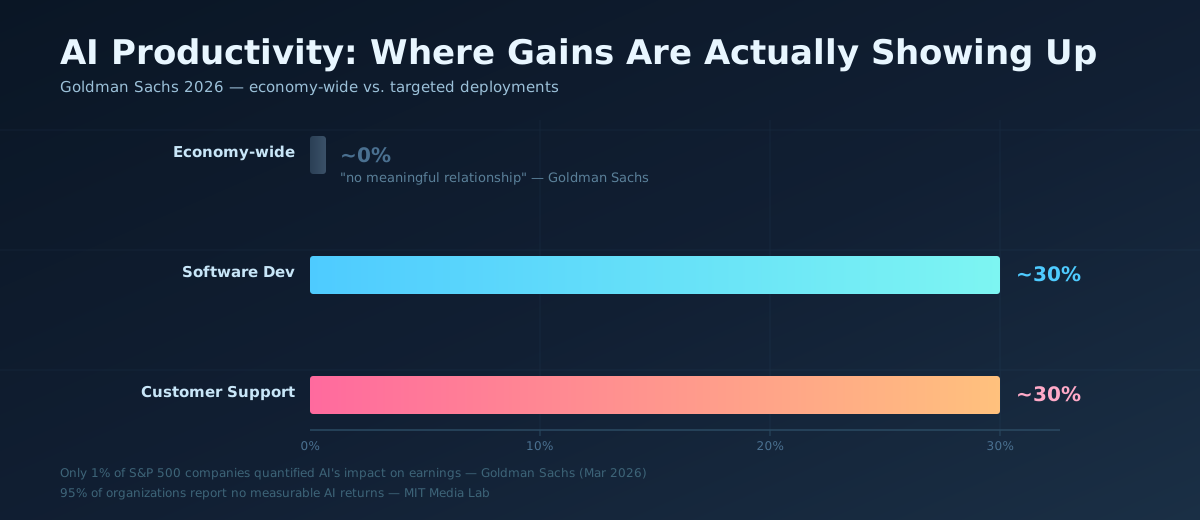
The Goldman finding comes with a nuance worth understanding: the economy-wide number hides real gains in two specific, narrow domains — software development and customer support, where median productivity improvements of around 30% are showing up. That is meaningful. It is also the entire list.
Outside those two use cases, the picture is bleak. MIT Media Lab research found that 95% of organizations report no measurable AI returns. Only 10% of S&P 500 management teams have quantified AI's impact on specific use cases. Only 1% have quantified its impact on earnings.
The gap between what the industry claimed and what organizations can actually measure is not a rounding error. It is the story.
Note: The Goldman finding does not mean AI has no future productivity impact — it means the timeline and distribution of that impact look nothing like what was promised in 2023. Broad economic transformation takes longer than hype cycles. That is not news; it is always true.
The counterpoint the optimists cite: employees at companies with ChatGPT enterprise accounts save 40–60 minutes per day on average, and 75% say they can complete tasks they previously couldn't. Those are real gains. The question is whether they show up in business outcomes — and at the 1% earnings quantification rate, the answer is: rarely, and rarely cleanly.
The $650B Question
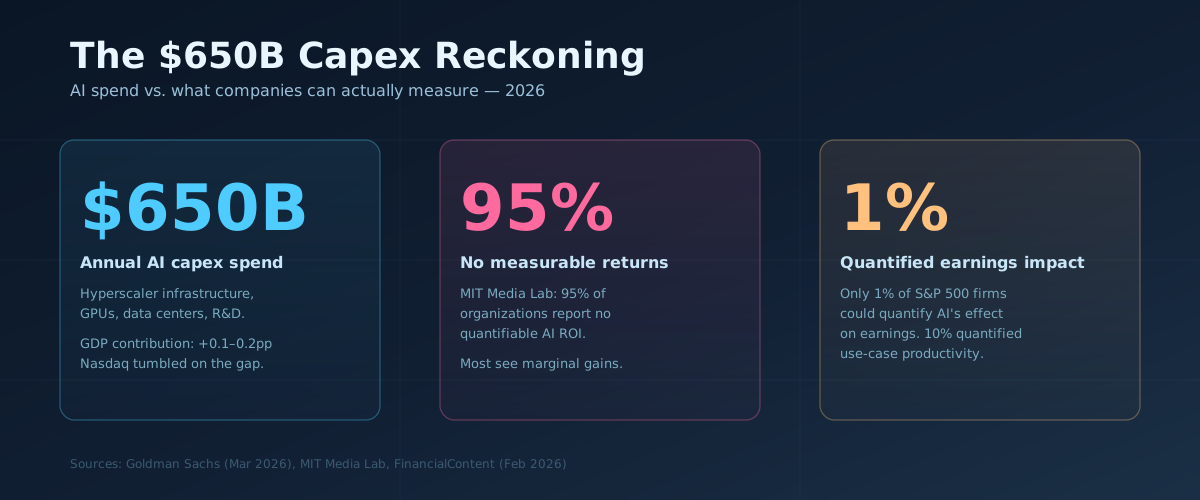
The hyperscalers committed roughly $650 billion in AI-related capex. In February 2026, Nasdaq tumbled when investors did the math: that spend contributes an estimated 0.1 to 0.2 percentage points to GDP growth. That is not a return on $650B. That is a very expensive infrastructure bet on a future that has not arrived yet.
"The Great Pivot of 2026" is not a metaphor — investors are actively rotating out of AI-premium equities and into what analysts are calling the "Old Economy." The AI premium that the market granted based on infrastructure growth and grand promises is being repriced against demonstrated results. The results are not there at scale.
Agentic AI compounds this. The claims are largest ("AI agents will automate most white-collar work") and the evidence is narrowest. Real-world agentic deployments remain brittle outside controlled tasks, hallucinate at critical moments, require constant human supervision, and deliver marginal ROI in most enterprise contexts. The benchmark numbers are impressive; the production reliability is not.
What the Skeptic Should Actually Do
The skeptic's error is the same as the believer's error: treating AI as a single thing with a single trajectory.
The Goldman data makes the picture precise: 30% productivity gains in coding and customer support are real and repeatable. If your work is in those domains, the tool is worth using aggressively. If your work is outside those domains, you are in the 95% — and the honest move is to design a small, measurable pilot before committing infrastructure spend.
The questions worth asking before any AI deployment:
- What is the specific task, and is it close to coding or high-volume text processing?
- What does success look like in numbers, not adjectives?
- Who owns the measurement, and what is their incentive?
The organizations that will get value from AI in 2026 are the ones asking those questions. The ones running AI-for-AI's-sake initiatives are producing the MIT Media Lab statistic.
Key Takeaways
- Goldman Sachs found no economy-wide productivity relationship with AI adoption — gains are real but confined to software development and customer support (~30% each).
- 95% of organizations report no measurable AI returns (MIT Media Lab); only 1% of S&P 500 companies have quantified AI's earnings impact.
- $650B in annual AI capex is contributing 0.1–0.2 percentage points to GDP — investors are repricing the AI premium against demonstrated results.
- Agentic AI claims are largest where evidence is thinnest — production deployments remain brittle outside narrow, controlled tasks.
- The right response is not to abandon AI but to scope pilots precisely, measure against baselines, and stay close to the two use cases where the data is actually good.
Sources
- Goldman Sachs: No Meaningful AI-Productivity Relationship, But 30% Boost in 2 Use Cases — Fortune
- AI in 2026: Hype vs. Reality — SmarterMSP
- The Day the AI Hype Met the Bottom Line — FinancialContent
- The Great Pivot of 2026 — FinancialContent
- AI Paradoxes: Why AI's Future Isn't Straightforward — World Economic Forum
Related Posts
- The State of AI Benchmarks in 2026 — Why benchmark scores look impressive while production results disappoint — the measurement problem explained.
- Agent Reliability Blueprint — What it actually takes to get agentic AI to production-grade reliability, and why most deployments don't get there.
- MLOps Is Just DevOps With More Humility — The operational discipline that separates AI projects that show ROI from ones that produce the MIT Media Lab statistic.
- AI Security & Sovereignty: The Gap Nobody Has Actually Closed — Another domain where the gap between claimed readiness and measured reality is wide.