The Agent Leap: Why 73% of Workplaces Now Run AI Agents (Up From 34%)
A year ago, 34% of workplaces said they were using AI agents. Now it's 73% — more than double, in twelve months, according to Google Cloud's Business Trends Report 2026.
A number like that invites two reactions. One is to treat it as proof that agents have arrived. The more useful reaction is to ask: 73% adopted what, exactly, and how many are actually getting something out of it?
Adoption is easy to claim and hard to verify. Value is the opposite. This post is about the distinction underneath the stat — what separates a workplace that genuinely runs on agents from one that has a chatbot bookmarked and calls it transformation.
The Number Everyone's Quoting
The industry is calling this shift "the agent leap" — shorthand for AI moving from answering questions to running processes. The framing you'll see everywhere is "tool to teammate." It's a reasonable one-liner, but it hides the mechanism: the interesting change isn't that the AI got smarter, it's that its job description changed.
A tool waits for you to use it. A teammate picks up a task, works it, and only comes back when something needs a decision only you can make. That's the real substance behind the "leap."
Chatbot AI vs Workflow AI: The Distinction That Actually Matters
Here's the plain-language version. There are two very different things people mean when they say "we use AI":
- Chatbot AI — you ask a question, the model answers, and the interaction ends. You decide what to do with the output and do it yourself. Everything downstream is still yours.
- Workflow AI (or agent AI) — the AI is handed an ongoing task, not a single prompt. It works through multiple steps on its own, checks its own confidence along the way, and only stops to hand off to a human at a point you defined in advance. Its job is the outcome, not just the answer.
Often the same underlying model. A completely different amount of ownership.
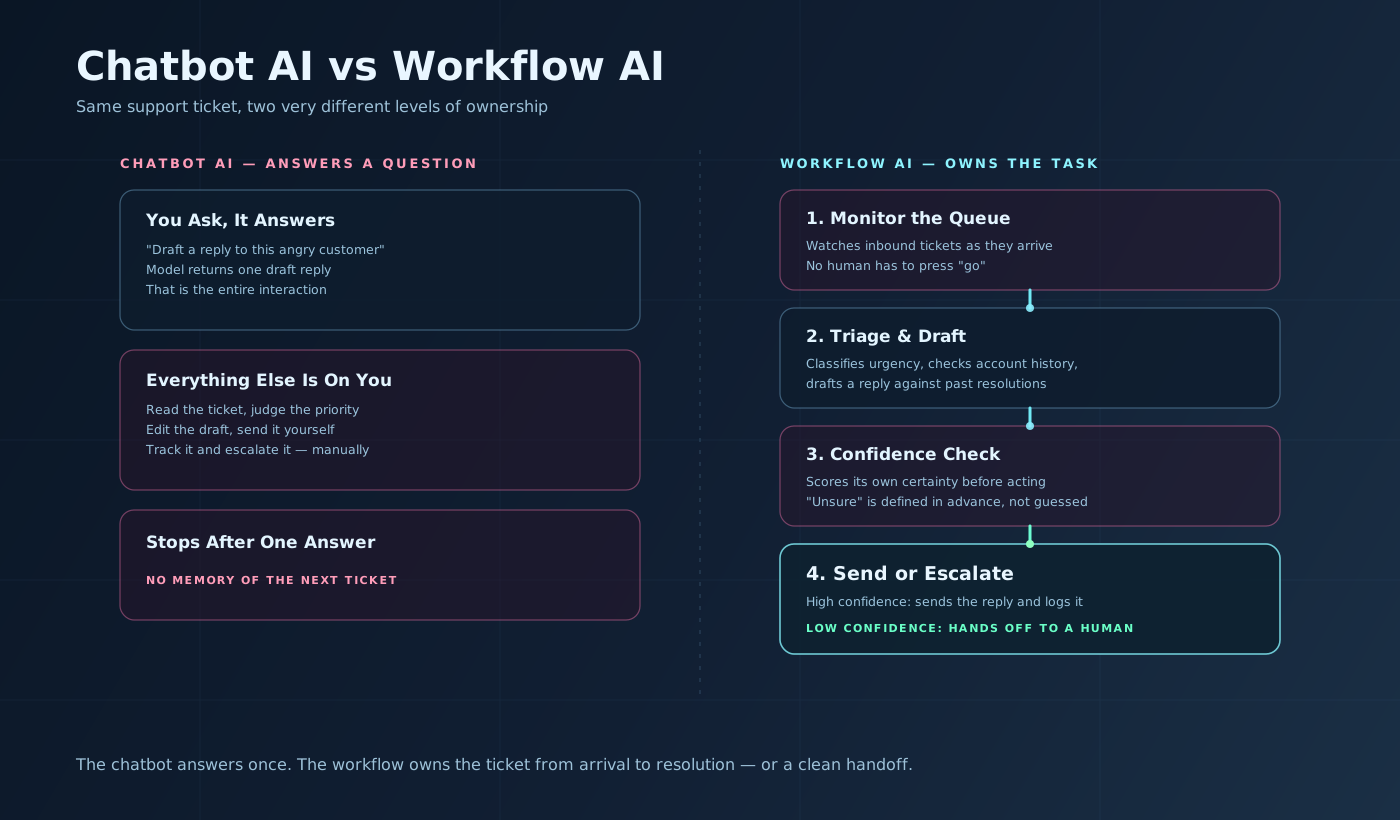
The chatbot answers once. The workflow owns the ticket from arrival to resolution — or a clean handoff.
Make it concrete with the most common example in the enterprise right now: customer support.
- Chatbot use: You paste a customer's angry email into a prompt and ask, "draft a reply to this." You get one draft back. You still have to notice the ticket existed, judge urgency, edit the draft, send it, and remember to follow up.
- Workflow/agent use: The AI watches the support queue itself. When a ticket arrives, it classifies the issue, checks the customer's history and account tier, and drafts a response grounded in how similar tickets were resolved before. Then it scores its own confidence. Confident, it sends the reply and logs the resolution. Not confident — an angry enterprise customer, a ticket open 30 days, a legal-sounding complaint — it routes to a human with full context attached, instead of guessing.
The second version isn't "the same chatbot, but faster." It's different software: a trigger, a multi-step plan, a self-assessment step, and — critically — a defined escalation point. That last part isn't optional. An agent without a designed handoff point isn't more autonomous, it's just more likely to fail silently.
Adoption Isn't the Same as Value
Here's the honest caveat: adoption statistics always run ahead of mature deployment. "73% have adopted AI agents" almost certainly means 73% have at least one agent doing at least one thing somewhere in the business — not that 73% have replaced a real operational process with one and are seeing measurable ROI.
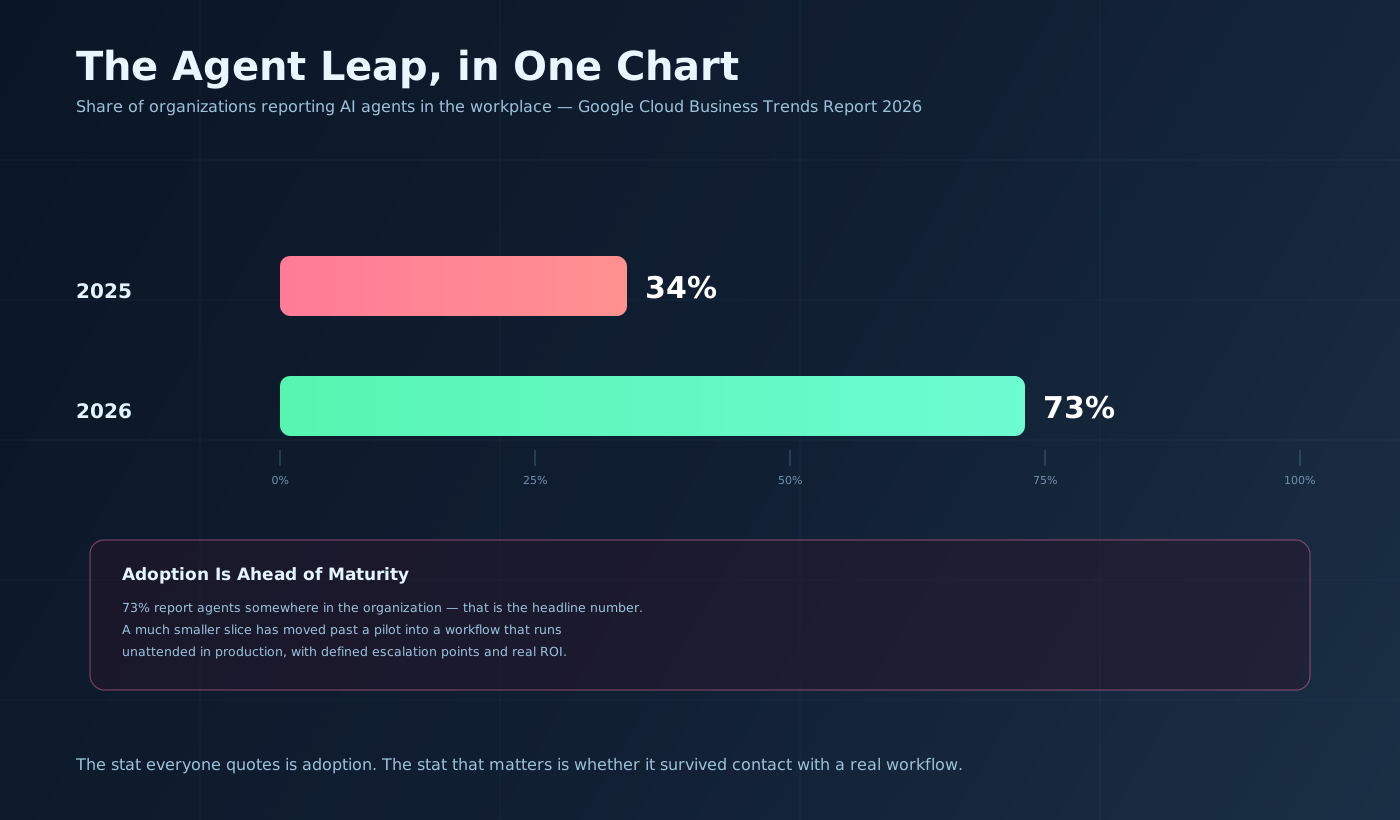
The stat everyone quotes is adoption. The stat that matters is whether it survived contact with a real workflow.
That gap isn't cynicism — it's how every adoption curve works. "We tried it" and "we depend on it" are separated by unglamorous engineering: error handling, escalation design, monitoring, and the willingness to say no to a use case that looked good in a demo but doesn't hold up under real inputs. The organizations getting real value are, by most reporting, the ones building AI into repeatable workflows — the same ticket-triage pipeline running thousands of times a day — rather than chasing one-off flashy demos. Workflow AI is winning over chatbot hype, and that's not a slogan, it's where the ROI is showing up.
Zoom out and this fits a bigger 2026 pattern: AI isn't just a feature bolted onto software anymore, it's reshaping the software lifecycle itself — how workflows get designed, who owns which step, what "shipping a feature" means when part of it is a semi-autonomous decision-maker. "AI is eating software" is a bold way to say it, but the claim underneath is modest: the unit of software is shifting from a screen a human clicks through to a process an agent runs, with a human as an escalation path rather than an operator.
What Separates the Successful 73% From Shelfware
If adoption is easy and value is hard, what predicts which side of that line a deployment lands on? A few things show up consistently in the workflow AI deployments that stick, versus the ones quietly abandoned six months in:
- A repeatable trigger, not a person remembering to use it. If the workflow only runs when someone opens the tool, it's still a chatbot wearing an agent's name tag.
- A designed escalation point, not a discovered one. Teams that define "what does 'unsure' mean, and what happens then" before launch ship agents that fail gracefully. Teams that skip this find out in production, the hard way.
- An owner for the failure mode. A named person is accountable for what happens when the agent gets it wrong — not "the AI," which cannot be held accountable for anything.
- Ongoing measurement, not a one-time demo. Success rate, escalation rate, and time-to-resolution are tracked over weeks, not judged once by an impressive first run.
- A narrow scope, on purpose. The workflows that survive tend to own one well-bounded process end to end, not "help with customer support" in general.
None of this is exotic. It's the same discipline that separates a reliable batch job from a script someone runs by hand. The models didn't need to get dramatically smarter for adoption to double — the industry needed to get better at wiring them into processes with real structure.
Key Takeaways
- Workplace AI adoption jumped from 34% to 73% in a year (Google Cloud Business Trends Report 2026) — but "adopted" and "getting value" are different claims.
- "Tool to teammate" really means ownership: a chatbot answers a question and hands control back to you; a workflow agent carries a task through multiple steps to a defined endpoint.
- The dividing line is the escalation point — agents that define "unsure, hand this to a human" in advance fail gracefully; agents that don't fail silently.
- Workflow AI beats chatbot-style usage because it's applied to repeatable processes, not one-off demos.
- "AI is eating software" means the unit of software is shifting from a UI a human operates to a process an agent runs with human escalation built in.
- The predictors of a deployment sticking are boring: a real trigger, a designed failure mode, an accountable owner, ongoing measurement, a narrow scope.
Related Posts
- Agentic AI: The Next Big Shift — the shift from single-shot LLM calls to autonomous multi-step systems
- Your AI Agent Just Got Fired — why polished agent demos fall apart against real business processes
- Agent Reliability Blueprint — the architecture that turns a demo into a production-grade deployment
- Repo-Level AI Agents: Whole-Codebase Reasoning — a concrete example of workflow-style agent reasoning
Is your team in the 73% that adopted, or the smaller slice actually running a workflow end to end? Tell me what's holding the last mile back — I'd bet it's the escalation design, not the model.