The Vibe Coding Hangover: The AI Code Quality Crisis of 2026
Every hangover starts with a good party. This one lasted about eighteen months.
In early 2025, Andrej Karpathy — a well-known AI researcher, one of the founding members of OpenAI — gave a name to something a lot of developers were already doing. He called it "vibe coding": you describe what you want in plain English, an AI agent writes the code, runs it, and fixes what breaks. You barely look at the code itself. You just check if it works.
It felt like magic. It also felt inevitable. Why read every line of code when you can just describe the outcome and let the machine handle the typing?
By August 2026, the industry knows the answer to that question. And it is not a fun one.
The Party
The appeal of vibe coding was never subtle. Writing software the old way is slow. You plan, you type, you debug, you test, you repeat. Vibe coding skipped most of that. Describe a feature, get a working version in minutes, ship it.
For prototypes and personal projects, this was genuinely great. For production systems handling real users, real money, and real data, it turned out to be a different story — one that took the industry about a year to fully notice, because "it works" and "it's safe" are two very different claims, and only one of them is easy to check by clicking around.
The Morning After
Here is what the data actually says once people started measuring instead of vibing.
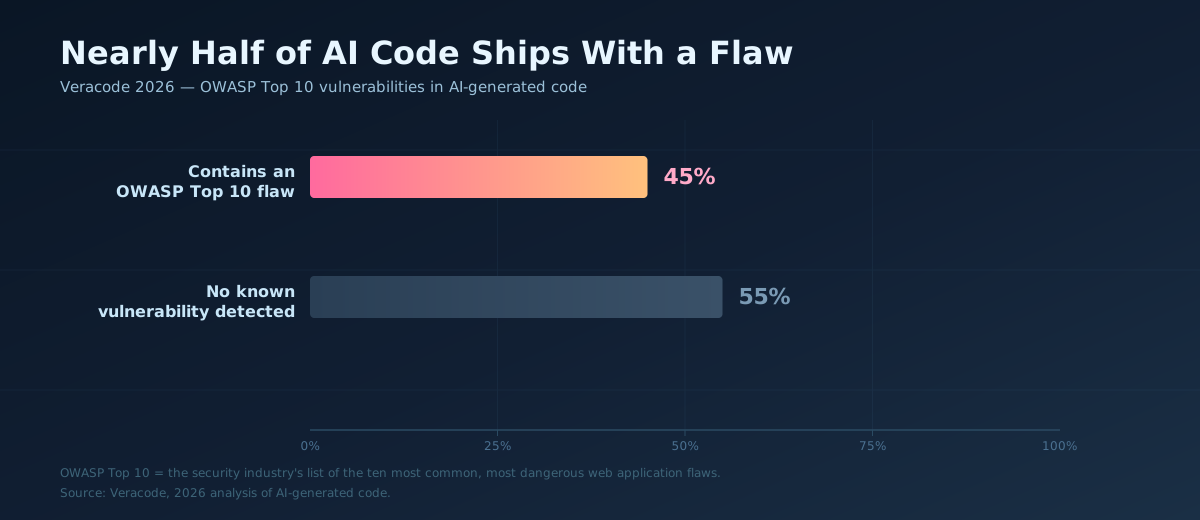
Veracode, a company that scans code for security flaws, looked at a large sample of AI-generated code and found that 45% of it contained at least one OWASP Top 10 vulnerability. OWASP Top 10 is simply the security industry's list of the ten most common and dangerous ways an application can be broken into — things like SQL injection, broken authentication, and exposed sensitive data. Nearly half of AI-written code had one of these baked in.
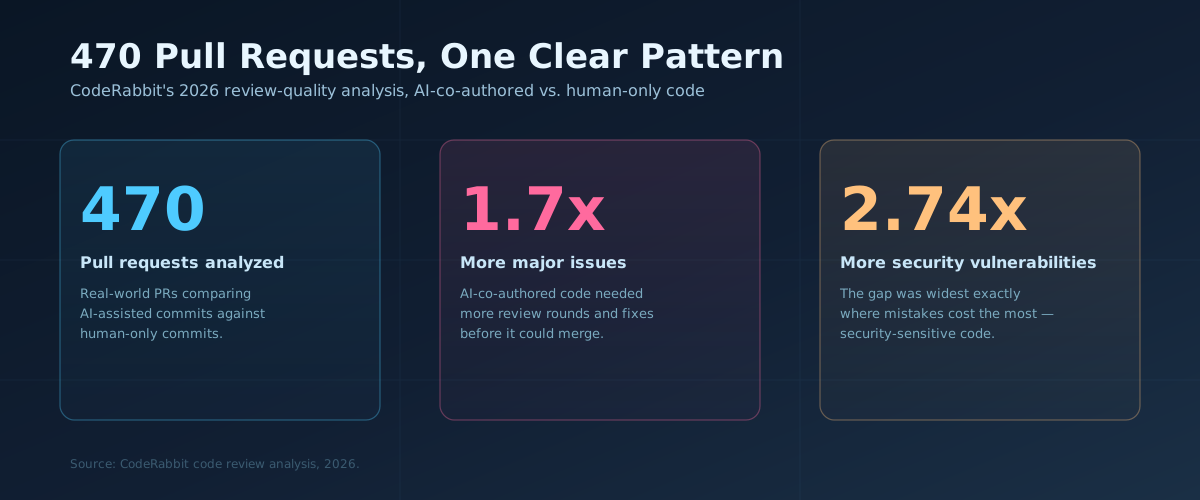
CodeRabbit, a code review tool, analyzed 470 real pull requests and found something just as telling: code co-written with AI had 1.7 times more major issues and 2.74 times more security vulnerabilities than code written without it. That is not a rounding error. That is a pattern.
None of this means the AI was "trying" to write bad code. It means the AI was optimizing for one thing — producing code that runs — while nobody was checking for the other thing that actually matters: code that runs safely, under real conditions, with real attackers looking for cracks.
The Tell: Karpathy Renamed His Own Term
Here is the detail that tells you everything about where things stand. In February 2026 — almost exactly one year after he coined "vibe coding" — Karpathy started using a different phrase: "agentic engineering."
Read that again. The person who invented the term is the person who walked away from it first.
"Vibe coding" was always about feeling — trusting the output because it felt right. "Agentic engineering" puts the word engineering back in the sentence. Engineering implies process: specs, testing, review, accountability. You don't "vibe" a bridge into existence. You engineer it, and then you check your work.
That single word swap is the whole story of 2026 in miniature. The industry didn't abandon AI-assisted coding. It abandoned the idea that AI-assisted coding doesn't need supervision.
The Economics Flipped
Here is the part that actually matters for your career, not just your code.
For twenty years, the expensive, scarce skill in software was writing code. Typing it, structuring it, getting it to work — that took time, training, and experience. Reading and reviewing code was the "quick" part, something you did in fifteen minutes before merging someone's pull request.
That balance just flipped. Writing code is now nearly free. An AI agent can generate a working feature in the time it takes you to make coffee. What's expensive now is knowing whether that code is correct, secure, and maintainable — because the agent that wrote it doesn't reliably know that itself, and as we've covered in our Agent Reliability Blueprint, getting an AI system to a trustworthy standard takes deliberate guardrails, not blind faith.
Think of it like a factory that just tripled its output line. Making more parts isn't the bottleneck anymore — having enough quality inspectors is. Right now, most teams shipping AI-generated code don't have enough inspectors. That gap is the vibe coding hangover.
Regulators Noticed Too
Governments move slowly, but they are not blind. The EU AI Act sorts AI tools into risk tiers — categories that determine how strictly a tool must be tested, documented, and monitored before it can be used. Regulators are now weighing whether AI coding tools used in regulated industries, like finance or healthcare, should be classified as "high-risk" — the tier with the most paperwork and the most legal exposure.
In the United States, several states are drafting vendor-liability legislation: laws that would make the company selling an AI coding tool partly responsible when that tool's output causes real damage. If that becomes normal, "the AI wrote it" stops being a legal shield and starts being an admission.
Neither of these has fully landed yet. But the direction is clear: unreviewed AI output is moving from "developer's problem" to "company's legal problem," which tends to get budget approved for review processes very quickly.
Why the Job Market Didn't Collapse
If AI can write code this fast, you'd expect fewer developer jobs. The opposite happened. Software engineer vacancies hit a three-year high in 2026.
Part of the reason is exactly what you'd guess from everything above: someone has to review, secure, and maintain the enormous volume of code that AI agents generated over the last eighteen months. Generating code got cheap. Owning it — understanding what it does, why it does it, and what happens when it breaks at 3 a.m. — did not. If anything, that skill just became more valuable, which lines up with what we described in From Prompt Engineer to Agent Architect: the career shift isn't away from engineering, it's toward the parts of engineering that AI still can't do for you.
That's also consistent with the pattern our Skeptic's Reality Check post found across the wider AI industry — real gains exist, but they show up narrower and messier than the hype promised, and they still need human judgment to turn into anything reliable.
The Hangover Isn't the End of the Party
None of this means vibe coding is dead. AI agents that write code are not going away, and honestly, they shouldn't — the productivity upside is real. What's ending is the idea that you can skip reading the code entirely.
The teams that come out of 2026 ahead are the ones treating AI output the way a good editor treats a first draft from a fast writer: useful, often good, never assumed correct until someone with judgment has looked at it. The teams that get burned are the ones still vibing on production systems in regulated industries, hoping the invoice never arrives.
It already did. It just had 45% security vulnerabilities on it.
Key Takeaways
- "Vibe coding" means describing what you want in plain language while an AI agent writes, tests, and deploys the code — coined by Andrej Karpathy in early 2025.
- Veracode found 45% of AI-generated code contains at least one OWASP Top 10 vulnerability; CodeRabbit found AI-co-authored code had 1.7x more major issues and 2.74x more security flaws across 470 real pull requests.
- In February 2026, Karpathy rebranded his own term to "agentic engineering" — a quiet admission that the discipline needs process, not just vibes.
- Regulators are catching up: the EU AI Act may classify AI coding tools as "high-risk" in regulated industries, and several US states are drafting vendor-liability laws.
- The job market didn't shrink — engineer vacancies hit a three-year high in 2026, largely because reviewing and maintaining AI-generated code is now the scarce, valuable skill.
- The real lesson isn't "stop using AI to code." It's "stop shipping AI code nobody reviewed."
Related Posts
- Agent Reliability Blueprint: SLOs, Guardrails, and Human Override — What it actually takes to make AI-driven systems trustworthy enough for production.
- The Real Cost of AI Agents: Security, Prompt Injection, and Trust — A closer look at how AI-written and AI-run systems become attack surfaces.
- From Prompt Engineer to Agent Architect — The career shift behind why review and oversight skills are suddenly in demand.
- The Skeptic's Reality Check: What AI Is Actually Delivering in 2026 — Where AI's productivity gains are real, and where the industry oversold them.
- Your AI Agent Just Got Fired — Why agentic AI still struggles to handle real business without human oversight.