AI's $650 Billion Data Center Bet: Where Is Cloud Spending Actually Going in 2026?
Global data center spending is projected to clear $650 billion in 2026 — a 31.7% jump over 2025, in a single year. For context, US tech spending overall is forecast to grow a record 8.3% in 2026, reaching $2.9 trillion. Data centers alone are outrunning that number by a wide margin.
It's easy to read $650 billion and file it under "AI is expensive, more at 11." That skips the useful question: where does the money actually go? A dollar spent on a GPU behaves nothing like a dollar spent on cooling or a dollar spent pouring concrete — each has a different timeline, a different bottleneck, and a different effect on you if you build on cloud or AI infrastructure.
Here's the spending broken into four concrete categories, plus what a jump this size signals for anyone shipping software in 2026 — not just "big number, therefore important."
Category 1: GPU and Accelerator Hardware — the Biggest Line Item
Compute hardware — GPUs, TPUs, and custom AI accelerators — dominates spending because training and serving today's models is fundamentally compute-bound. A single high-end accelerator can cost tens of thousands of dollars, and a modern training cluster wires tens of thousands of them together. Inference adds a second, continuous demand for the same chips. Every larger context window and every new modality increases the chip count needed just to keep up.
- What it funds — GPU/TPU/accelerator purchases, the servers that host them, and the specialized memory tightly coupled to them.
- Why it dominates — chip supply has been the tightest constraint in the stack for years; scarce supply plus surging demand pushes unit price and volume up together, and cloud providers who secure allocation early gain a real competitive edge.
Category 2: Power and Cooling — the Quiet Constraint
AI racks draw dramatically more power per square foot than the servers running a typical website or database five years ago — a rack of general-purpose servers might draw 5-10 kilowatts; a rack dense with AI accelerators can draw several times that in the same footprint.
That cascades through the whole facility: a larger electrical supply, new substation capacity, new long-term power contracts, and sometimes entirely new generation capacity built to serve one campus. Air cooling, fine for decades of conventional server rooms, increasingly can't remove heat fast enough — which is why liquid cooling has gone from niche to standard in new AI facilities.
- What it funds — electrical infrastructure, substations, long-term power contracts, and liquid cooling replacing or supplementing air cooling.
- Why it's growing fastest — power availability, not chip supply, is increasingly the actual limit on how fast new capacity comes online, and it's the category most tied to geography since some regions simply have more spare grid capacity.
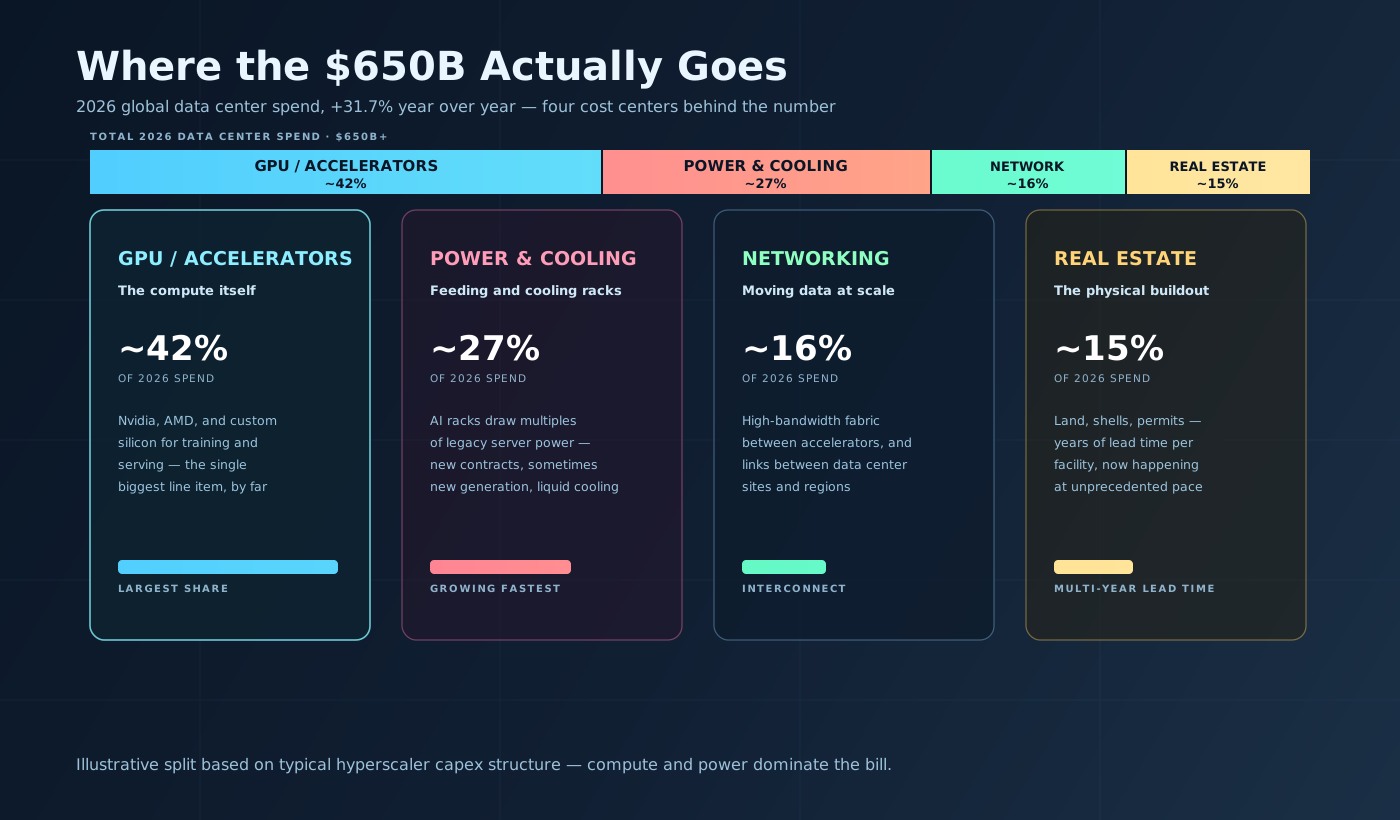 An illustrative breakdown of where 2026 data center dollars go — compute hardware and power/cooling together account for roughly two-thirds of the bill.
Category 3: Networking and Interconnect — Moving the Data
Compute is useless if data can't move fast enough to feed it. Training a large model means constantly shuttling huge volumes of data between thousands of accelerators working in parallel — any delay leaves expensive chips sitting idle, close to the worst outcome for a capital-intensive resource.
That funds two kinds of networking: inside a data center, high-bandwidth, low-latency fabric connecting accelerators to each other — purpose-built interconnect, not general-purpose enterprise gear. Between data centers and regions, dedicated high-capacity links so data and inference requests move across a provider's footprint without bottlenecking.
- What it funds — accelerator-to-accelerator interconnect fabric, data center backbone networking, and inter-region links.
- Smaller share, real constraint — a smaller slice of total spend than compute or power, but a poorly provisioned network can bottleneck a cluster that otherwise has all the GPU capacity it needs.
Category 4: Real Estate and Construction — the Physical Buildout
The least glamorous category is also the slowest-moving, which is why it matters. A new data center requires land, zoning, permitting, years of construction, and utility coordination — a process that can take two to four years from site selection to a live facility, even when everything goes smoothly.
That lead time is exactly why 2026's construction is happening at an unprecedented pace: providers are breaking ground now on capacity they'll need in 2028 and beyond, because buildings can't be rushed the way a software rollout can. Spending here today is a bet on demand years out.
- What it funds — land acquisition, permitting, shell construction, and physical build-out of new campuses.
- The caveat worth naming — this category is most exposed if AI demand growth slows before these buildings finish; a facility greenlit under 2026 assumptions is a multi-year commitment regardless of how demand plays out.
What a 31.7% Jump Actually Signals
This changes the operating conditions for anyone building on cloud or AI infrastructure near-term:
- Compute pricing stays under upward pressure. Demand for accelerators and power is outrunning supply of both — expect GPU-hour and inference pricing to stay firm even as chip performance improves.
- Efficiency gains are real, but a longer game. Each chip generation and architecture improvement lowers cost per unit of useful compute — genuine, but it plays out over hardware cycles, not quarters.
- Capacity constraints concentrate in popular regions. With power now as much a bottleneck as chip supply, expect uneven capacity — tightest in the most in-demand regions.
- Providers with scarce GPU supply gain leverage. When compute is the tightest input, whoever can guarantee allocation, not just price, has the stronger hand in enterprise deals.
- The capital intensity is reshaping the architecture and the risk profile — it's a direct driver of the shift toward hybrid, multi-cloud, and sovereign infrastructure (see Cloud 3.0, Explained), and it's exactly why analysts are flagging elevated outage risk for 2026 (see Why 2026 Is Set Up for Its First Multi-Day Cloud Outage).
None of this makes the spending irrational — today's models genuinely require this much compute, power, and infrastructure. It does mean "prices will come down soon" isn't a safe budgeting assumption for 2026. Plan for the current cost structure to persist.
Key Takeaways
- Global data center spend is projected to exceed $650 billion in 2026, a 31.7% jump in a single year — well above the broader 8.3% growth forecast for US tech spending overall.
- GPU and accelerator hardware is the largest spending category because training and serving modern models is fundamentally compute-bound, and chip supply has stayed the tightest constraint in the stack for years.
- Power and cooling is the fastest-growing, most physically constraining category — AI racks draw far more power per rack than legacy servers, forcing new power contracts, sometimes new generation capacity, and a shift to liquid cooling.
- Networking and interconnect is a smaller share of spend but a real bottleneck risk — thousands of accelerators only function as one system if data moves between them fast enough.
- Real estate and construction spending today is a bet on demand two-plus years out, since physical buildout takes years and can't be rushed the way software can.
- For builders: expect pricing pressure near-term, uneven capacity across regions, and providers with secured GPU supply to hold more leverage — budget around today's cost structure, not an assumed drop.
Related Posts
- Cloud 3.0, Explained: What 'Sovereign Cloud' Actually Means for Your Stack — the architectural shift this spending surge is driving.
- Why 2026 Is Set Up for Its First Multi-Day Cloud Outage — the operational risk that comes with expanding capacity this fast.
- GPT-5.6's Sol, Terra, and Luna Tiers, Explained — how infrastructure cost eventually shows up as per-token model pricing.
- Stop Fine-Tuning GPT-5. A 7B Open-Source Model Will Beat It on Your Use Case — matching model size to actual task difficulty matters more when compute is this expensive.
Are you seeing GPU allocation or power constraints show up in your own infrastructure planning yet? Drop your experience in the comments — it's useful signal for what "capacity constrained" actually looks like on the ground.