A medical billing team I know spent three months prompt-engineering GPT-5 to classify ICD-10 codes from clinical notes. F1 score: 0.81. They fine-tuned Mistral 7B on 12,000 of their own labeled records. F1 score: 0.89. Monthly inference cost dropped from ~$4,200 to ~$90.
That is not an outlier. That is the pattern.
Why GPT-5 Is Not the Right Tool for Your Problem
GPT-5 is a generalist. It was trained on a corpus broad enough to answer questions about Renaissance painting, write regex, and explain semiconductor physics in the same breath. That breadth is exactly what makes it mediocre at your specific, narrow task.
A general model has to allocate its representational capacity across everything. A domain-specific fine-tuned model allocates all of it to one thing: your data, your schema, your edge cases, your vocabulary.
The benchmark numbers — MMLU, HumanEval, GPQA — do not tell you how well a model classifies your internal support tickets. They tell you how well it passes a standardized test. As covered in AI Benchmarks 2026, those numbers are increasingly meaningless for production decisions. What matters is whether your eval set improves, and a 7B fine-tuned on in-domain data routinely wins that comparison against a 70B+ generalist.
The Architecture Argument in One Diagram
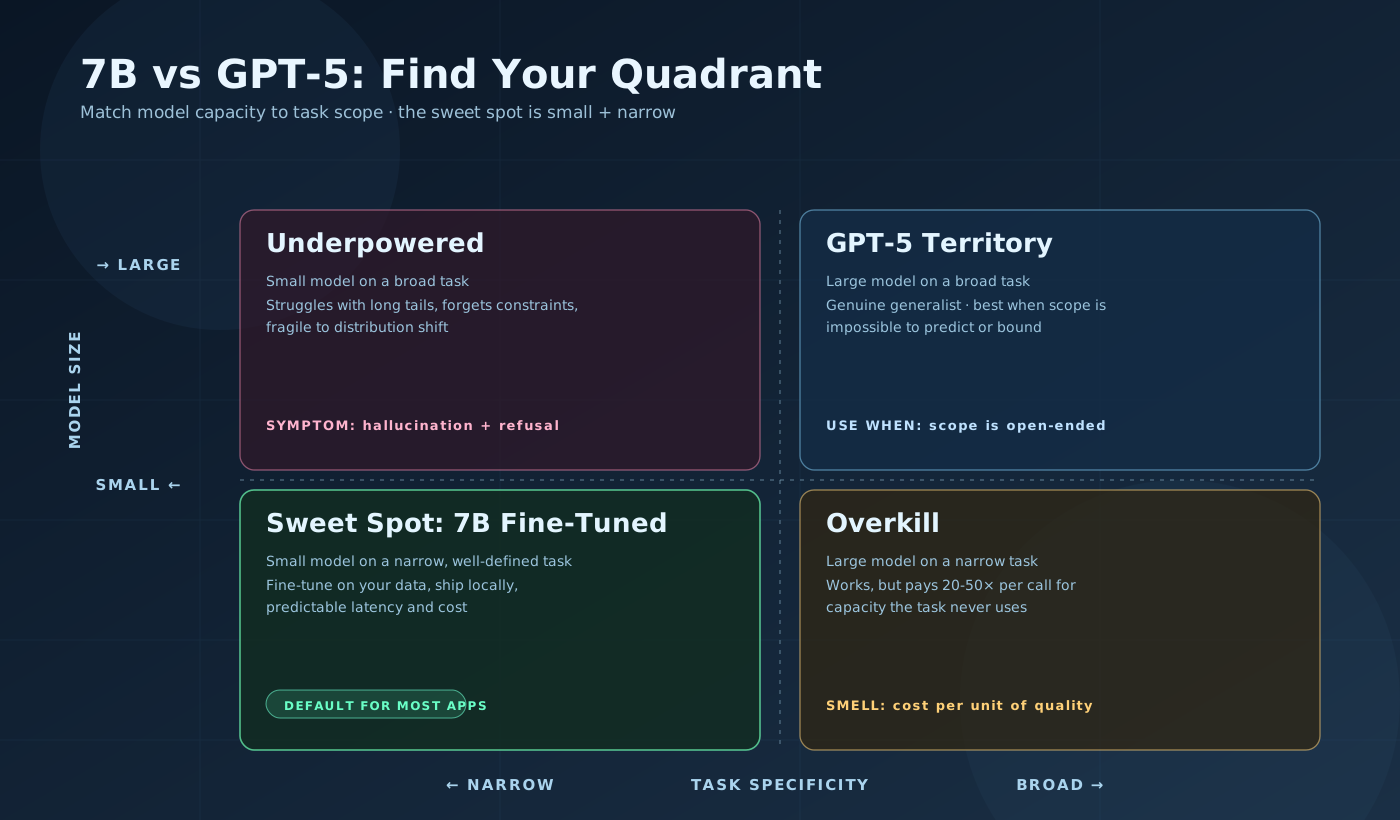 Deploy where your use case actually lives. Most production workloads are narrow-task — that puts them bottom-left.
What the Code Actually Looks Like
Here is the GPT-5 approach: a carefully engineered system prompt, few-shot examples baked into the context window, and a JSON mode call to get structured output. It works, and it costs you every time.
# GPT-5 with prompt engineering
# ~$0.042 per 1K tokens (input+output) — adds up fast at scale

response = openai_client.chat.completions.create(
    model="gpt-5",
    messages=[
        {
            "role": "system",
            "content": (
                "You are a medical coding specialist. Given a clinical note, "
                "return the most specific ICD-10-CM code. Output JSON with keys "
                "'code' and 'confidence'. Use the following examples as reference:\n"
                + FEW_SHOT_EXAMPLES  # 800–1200 tokens of examples every call
            ),
        },
        {"role": "user", "content": clinical_note},
    ],
    response_format={"type": "json_object"},
)
Now here is the fine-tuned Mistral 7B call. No system prompt. No few-shot examples. The knowledge is in the weights.
# Fine-tuned Mistral 7B via vLLM or any OpenAI-compatible endpoint
# ~$0.0008 per 1K tokens self-hosted — roughly 50x cheaper

response = local_client.chat.completions.create(
    model="mistral-7b-icd10-v2",  # your fine-tuned checkpoint
    messages=[
        {"role": "user", "content": clinical_note},
    ],
    response_format={"type": "json_object"},
)
The second call is faster, cheaper, and — if your training data was good — more accurate on your specific distribution. The few-shot examples that GPT-5 needed to perform are now part of the model's prior. You paid for that once at training time, not on every inference request.
When This Does Not Apply
Fine-tuning for a narrow task wins when the task is genuinely stable and narrow. It loses when:
- Your data distribution shifts frequently (fine-tuning becomes a maintenance burden — see Why RAG Beats Fine-Tuning for the retrieval alternative)
- You need multi-step reasoning across unpredictable topics
- You do not have enough labeled examples to close the distribution gap (under ~1,000 high-quality pairs, the fine-tune rarely beats a well-prompted GPT-5)
The quadrant diagram above is the test: if your task is narrow and your data is in-domain, you are in the bottom-left. That is not GPT-5 territory.
The Real Cost of Using the Wrong Tool
The $4,200 vs. $90 number is real, but the less-visible cost is accuracy. Teams often accept a lower-performing general model because it was faster to deploy. They end up building increasingly elaborate prompt scaffolding to compensate for a model that simply does not know their domain. That scaffolding compounds — more tokens, more latency, more fragility.
A fine-tuned 7B is not a compromise. On a narrow task with good training data, it is the correct architectural choice. The model is smaller, cheaper, faster, and better at the one thing you actually need it to do.
Pick the right tool. Production LLM pipelines are already complex enough without paying a premium for capabilities you are never going to use.
Key Takeaways
- GPT-5's generalist training is a liability on narrow tasks, not an asset
- A fine-tuned 7B on in-domain data consistently outperforms prompt-engineered large models on classification and extraction tasks
- The cost delta (~50x) is large enough to affect product economics at any meaningful scale
- Fine-tuning is the wrong choice when data is sparse or the task distribution is unstable — reach for RAG in those cases
- Benchmark scores are irrelevant; your domain-specific eval set is the only number that matters
Related Posts
- Why RAG Beats Fine-Tuning for Most Use Cases — when retrieval is the better lever
- AI Benchmarks 2026 — why leaderboard numbers mislead production decisions
- Building a Production LLM Pipeline — end-to-end architecture for shipping LLM features
Running different numbers on your stack? Drop the eval results in the comments — I want to see where this pattern breaks.