Cloud 3.0, Explained: What 'Sovereign Cloud' Actually Means for Your Stack
"Cloud 3.0" showed up in Capgemini and Google Cloud trend reports this year, and it has the unmistakable smell of a rebrand. Mostly, it is one. But underneath the label is a real shift: fewer teams defaulting to "one big provider, one region, done," and more deliberately splitting workloads across hybrid, multi-cloud, and sovereign cloud architectures — not because it's trendy, but because AI workloads revived an old question: where does this data actually live, and who is legally allowed to touch it?
If you run infrastructure for a living, that question is about to show up in a vendor contract or a compliance audit near you. Here is the concrete version — what each term actually requires you to build, why it's accelerating now, and what it costs.
Cloud 3.0 Is a Label, Not a Product
Cloud 1.0 was lift-and-shift: move the data center workload onto a public cloud VM and call it modernization. Cloud 2.0 was cloud-native: containers, managed services, one hyperscaler chosen mostly for price and latency. Cloud 3.0 is architecture as a per-workload decision instead of a company-wide default — some workloads stay on the cheapest public region, some split across providers, some get locked into a specific jurisdiction because a regulator or a contract requires it.
The scale is real: US tech spending is forecast to grow a record 8.3% in 2026 to $2.9 trillion, and global data center spend is projected to exceed $650 billion — a 31.7% jump in a single year. I cover where that money is going in AI Data Center Spending in 2026. What matters here is the shape: it's diversifying into hybrid, multi-cloud, and sovereign tracks in parallel, not just getting bigger in one place.
What "Sovereign Cloud" Actually Means
This term gets thrown around loosely, so let's define it precisely.
Sovereign cloud is infrastructure where data residency, operational control, and legal jurisdiction are guaranteed — contractually and technically — to stay within a specific country or region. It is driven by regulation: GDPR-style residency laws, government contracts, industry-specific compliance. Chosen because the law or the customer requires it, not for cost or latency.
That is genuinely different from two terms people conflate with it:
- Hybrid cloud — mixing on-premises infrastructure with public cloud. About where compute physically runs, not legal jurisdiction.
- Multi-cloud — using two or more providers, typically for redundancy or negotiating leverage. Says nothing about jurisdiction by itself.
- Sovereign cloud — residency, control, and jurisdiction locked down as a contractual guarantee, independent of cost or performance.
In practice, "sovereign cloud" is a handful of concrete mechanisms, not a checkbox:
- A region purpose-built for jurisdictional guarantees — not just "the EU region," but offerings like AWS's European Sovereign Cloud or Azure's sovereign regions in Germany and France.
- Contractual guarantees on backups, logs, and metadata, not just primary data — a promise covering only the database while logs replicate to a US region is a gap an audit will find.
- Personnel restrictions, sometimes limiting support staff to citizens or residents of the covered jurisdiction, so a foreign government can't compel access through a foreign employee.
- Sometimes an entirely separate product — AWS GovCloud, Google Cloud's sovereign controls, Azure's sovereign regions — with their own certifications, not a region flag on the standard offering.
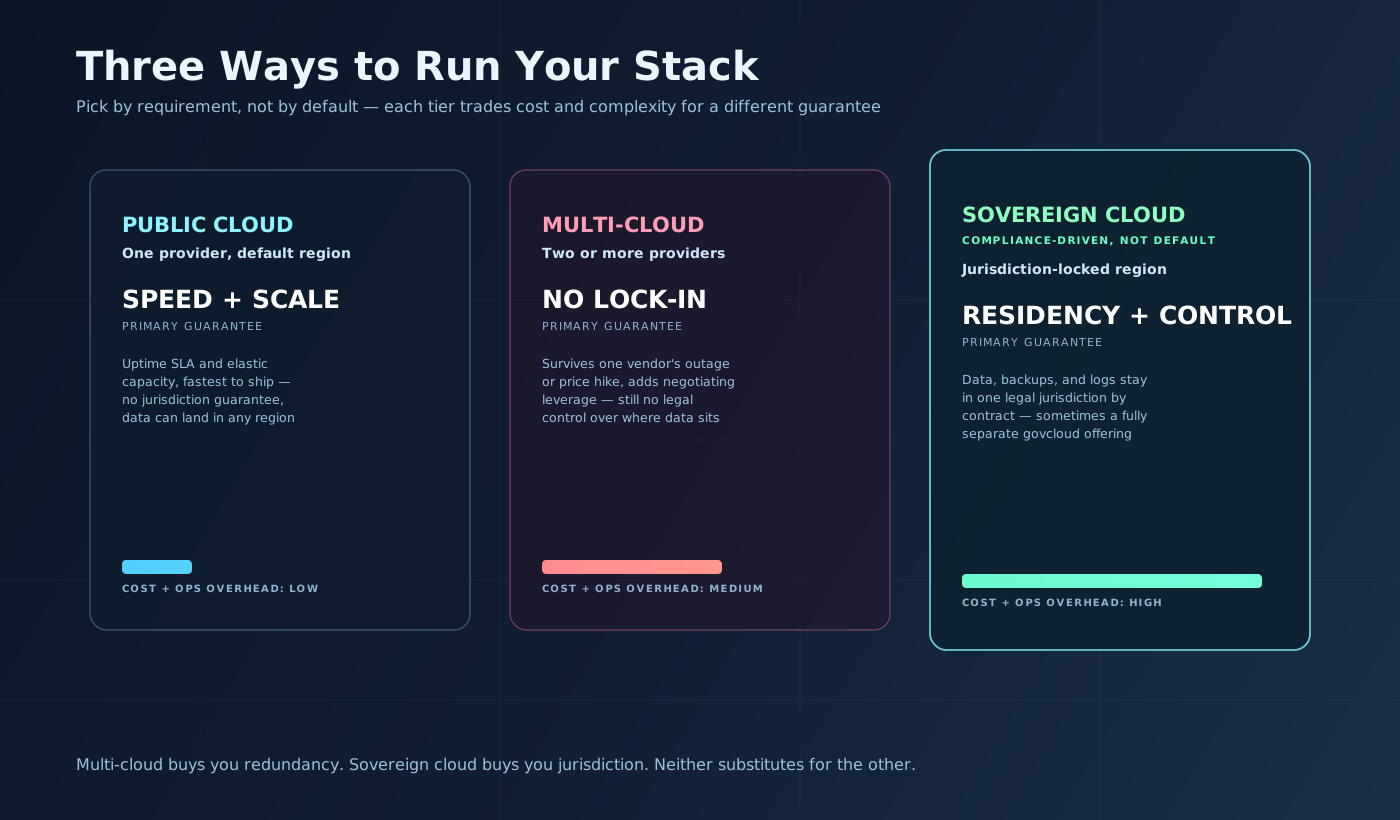 Multi-cloud buys you redundancy. Sovereign cloud buys you jurisdiction. Neither substitutes for the other.
Why This Is Accelerating Right Now: AI Changed the Stakes
Residency law is not new — GDPR is eight years old. What's new is how much more exposed AI workloads are than a typical web app, and that's why "sovereign cloud" jumped from a niche public-sector concern to a mainstream decision.
A conventional web app moves structured, low-volume data through a database and a few APIs. An AI pipeline is different: training data at a scale nobody would have shipped to a third party a few years ago, RAG pipelines pushing chunks and embeddings through vector stores that may not share a jurisdiction with the source data, and inference traffic where every prompt leaving your infrastructure can carry PII or trade secrets embedded in the context window.
Concrete case: a healthcare provider builds RAG over patient records so clinicians can query treatment history in natural language. If the vector database or inference endpoint sits in a different jurisdiction than the data controller, that's a residency violation that didn't exist when this was "just a website with a login page." The AI layer introduced the exposure — the law didn't change.
I go deeper on the security mechanics of this gap in AI Security & Sovereignty, which covers the broader "processed, not just stored" problem. This post stays narrower: which cloud patterns you reach for, and what each buys you. Enforcing a jurisdiction lock in practice means a Terraform module that refuses to provision outside an approved region list — see Terraform + MCP + AI Agents for keeping agent-driven infrastructure inside guardrails like that.
The Honest Tradeoff: This Costs More, and It Is Not Simpler
Sovereign and multi-cloud architectures are not a free upgrade. They are a deliberate, expensive tradeoff for compliance and risk reduction — not a strictly better version of "just use one big provider's default region."
- Higher direct cost — sovereign offerings often carry a premium, and multi-cloud means paying for redundant capacity you don't always use.
- Duplicated operational surface — separate IAM, observability, and incident runbooks per provider or region, since one pane of glass across sovereign and non-sovereign infrastructure is hard to build.
- Region-locked CI/CD — your pipeline must know which workloads may touch which regions and enforce it automatically, because one manual mistake breaks the guarantee silently.
- Key management per jurisdiction — keys often need to be generated and rotated within the same jurisdiction as the data they protect, ruling out centralized setups.
None of that is complexity you can engineer away — it's the cost of the guarantee. That discipline is the same territory covered in MLOps Is Just DevOps With More Humility: more moving parts means more ways for a silent failure to slip past you.
So when do you actually reach for each tier?
- Default public cloud — no regulatory mandate ties data to a jurisdiction, and cost or speed-to-ship dominates. Covers most workloads; don't add overhead you don't need.
- Multi-cloud — outage resilience or negotiating leverage matters more than jurisdiction. Not a substitute for legal control over data location.
- Sovereign cloud — a regulator, contract, or compliance framework specifically requires jurisdictional guarantees. Adopt it because you're told to, not because it sounds more secure.
This buildout is happening because AI raised the stakes on a question that used to be someone else's problem — not because sovereign cloud is inherently better engineering.
Key Takeaways
- "Cloud 3.0" means choosing hybrid, multi-cloud, or sovereign architecture deliberately per workload, not defaulting everything to one provider's default region.
- Sovereign cloud guarantees data residency, operational control, and legal jurisdiction — enforced contractually and technically, not just "the EU region."
- In practice: locked jurisdictional regions, contractual backup/log guarantees, and sometimes a fully separate offering like AWS GovCloud.
- AI workloads are the accelerant: training data, RAG pipelines, and inference traffic move far more sensitive data through far more third-party touchpoints than a web app ever did.
- Multi-cloud solves for redundancy and vendor leverage; sovereign cloud solves for jurisdiction — neither substitutes for the other.
- Sovereign and multi-cloud architecture cost more and add real operational overhead. Adopt them because a regulation or contract requires it, not because it sounds more secure.
Wiring jurisdiction locks into your own infrastructure right now? I'd like to know what broke first — the IAM boundary, the CI/CD pipeline, or the backup replication you forgot about. Drop it in the comments.
Related Posts
- AI Security & Sovereignty: The Gap Nobody Has Actually Closed — The broader security and compliance picture; this post is the narrower architectural companion on which cloud patterns to reach for.
- Terraform + MCP + AI Agents: The New Infrastructure Stack Nobody's Talking About — IaC patterns for enforcing region locks in multi-region or sovereign deployments.
- MLOps Is Just DevOps With More Humility — The operational discipline sovereign and multi-cloud architectures demand once you add more moving parts.
- AI Data Center Spending in 2026 — Where the $650B in 2026 data center spending is actually going.
- The 2026 Cloud Outage Risk Nobody's Pricing In — Why this same AI-driven infrastructure boom raises real outage risk.