Why 2026 Is Set Up for Its First Multi-Day Cloud Outage
In October 2025, an AWS outage disrupted businesses across multiple regions. A month later, Azure had one of its own, knocking services offline globally. Most people filed both under "cloud had a bad day, business as usual." Forrester reads them differently: as previews.
The research firm's prediction for 2026 is specific and uncomfortable — AI data-center capacity upgrades will trigger at least two major multi-day cloud outages this year. Not brief blips. Multi-day.
That's a prediction, not a confirmed event, and this post isn't a doom read. But the reasoning behind it holds up, and there's already a trail of smaller 2026 incidents that fit the pattern. More usefully: there are concrete things you can do at the application layer that reduce your exposure whether or not the "big one" actually lands this year.
Let's walk through why AI workloads strain cloud infrastructure differently than the traffic clouds were built for, what's already happened this year, and what resilience actually looks like in practice.
Why AI workloads break the old assumptions
Cloud infrastructure was hardened over roughly fifteen years around a fairly predictable traffic shape: web requests, database queries, batch jobs. Spiky at times, but spiky in ways operators learned to model and absorb.
AI workloads don't behave like that:
- Power and cooling demand is lumpy, not smooth. Training runs and large inference bursts pull enormous, concentrated power draws in short windows. Traditional power and cooling systems were engineered around steadier load curves — GPU clusters stress them differently.
- The hardware is newer and less battle-tested. Every hyperscaler is racing to bring new GPU capacity online — new rack densities, new liquid-cooling systems, all deployed under time pressure. New infrastructure fails in ways old infrastructure already had the bugs worked out of.
- Operational playbooks haven't caught up. A data center running the same workload class for a decade has incident runbooks and known failure modes. One that stood up its AI capacity eighteen months ago is still discovering what breaks.
- The blast radius is bigger now. More production systems — including AI agents taking real actions — now depend on this infrastructure. A 2015 regional outage meant your website was slow. A 2026 regional outage can take your agent pipeline, support automation, and website down together, because they all sit on the same region.
None of this means providers are being careless. It means they're building extremely fast, and speed and operational maturity are usually in tension.
The scale behind the rush
Here's the number that puts the pressure in context: global data-center spending is projected to exceed $650 billion in 2026 — a 31.7% jump in a single year. That's not incremental growth; it's an industry building out capacity as fast as it possibly can to keep up with AI demand.
Rapid capacity expansion is exactly the kind of environment where operational risk accumulates — new hardware, new power and cooling systems, new regions coming online faster than the operational maturity that normally accompanies infrastructure at scale. Nobody is cutting corners intentionally. Maturity just takes time, and the growth curve isn't waiting for it.
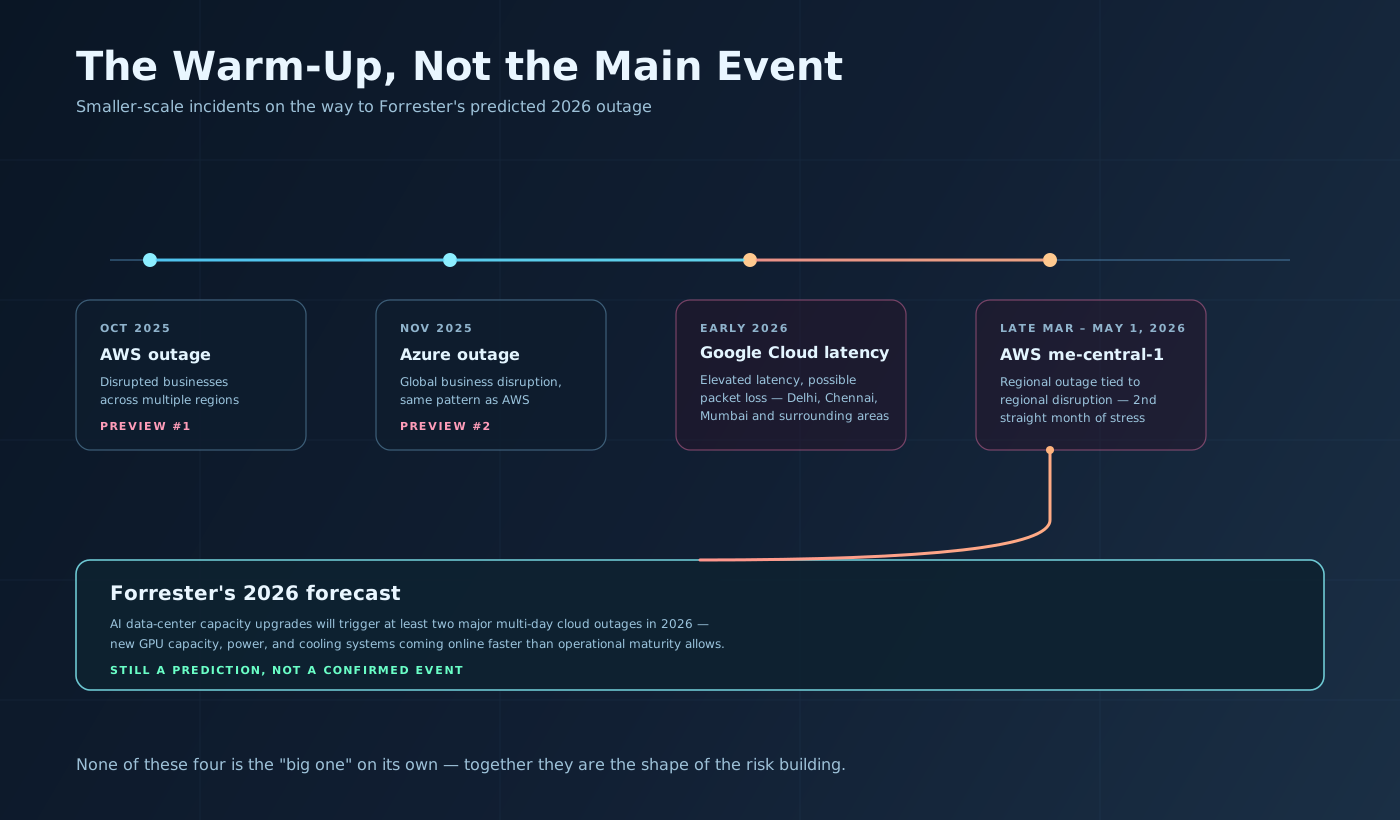 Four smaller-scale incidents, one pattern — none of them is "the big one" Forrester is forecasting.
What's already happened in 2026
The predicted "big one" hasn't landed yet. But 2026 has already produced smaller incidents that fit the exact pattern Forrester describes — not confirmation, but evidence the underlying conditions are real:
- Google Cloud, early 2026 — intermittent elevated latency and possible packet loss affecting traffic through Delhi, Chennai, Mumbai, and the surrounding areas. Not a full outage, but a sustained degradation signal in a region carrying serious load.
- AWS me-central-1, late March through May 1, 2026 — a regional outage tied to Iranian-strikes-related regional disruption. The second straight month of documented operational stress in that region, which matters more than one isolated incident would.
Neither is the multi-day, headline-grabbing event Forrester is forecasting. They're smaller, regional, and recovered from quickly. That's the point — they're consistent with an infrastructure layer under more strain than it was two years ago, which is exactly the condition that makes a bigger failure more likely, not less.
What resilience actually looks like at the application layer
Here's the part that matters regardless of whether Forrester's prediction plays out exactly as stated. You don't control when your cloud provider has a bad week. You do control how your application behaves when it does.
Treat a cloud region the same way you'd treat any other single point of failure. If you wouldn't accept a single database instance with no replica for a critical system, don't accept a single region either. Plenty of production systems — including AI agent pipelines shipped in the last year — quietly depend on one region because multi-region felt like premature optimization at launch time.
Concrete patterns that actually help:
- Multi-region failover for anything customer-facing or revenue-critical. Doesn't have to mean full active-active on day one. Even a warm standby in a second region, with health checks and automated failover, turns "we're down" into "we're degraded."
- Graceful degradation instead of hard-fail. When a dependency is unavailable, the right answer is rarely "throw a 500 and stop." Serve cached or stale data. Queue writes for later reconciliation. Turn off the expensive feature and keep the cheap one running.
- Decouple your AI agent's control plane from its execution plane. If orchestration and model inference live in the same region with no fallback, an outage doesn't just slow you down — it takes decision-making offline. Same posture worth applying to production agent systems generally: treat model calls and tool calls as independently failable, and design for that.
- Test the failover path before you need it. A failover mechanism nobody has exercised since it was built is a mechanism you don't actually have. Run drills that simulate a region going dark and confirm traffic actually reroutes.
- Know your actual blast radius. Map out, concretely, what breaks if your primary region goes down for six hours — with actual owners, not just in theory. Most teams find the gaps in this exercise, not in the outage itself.
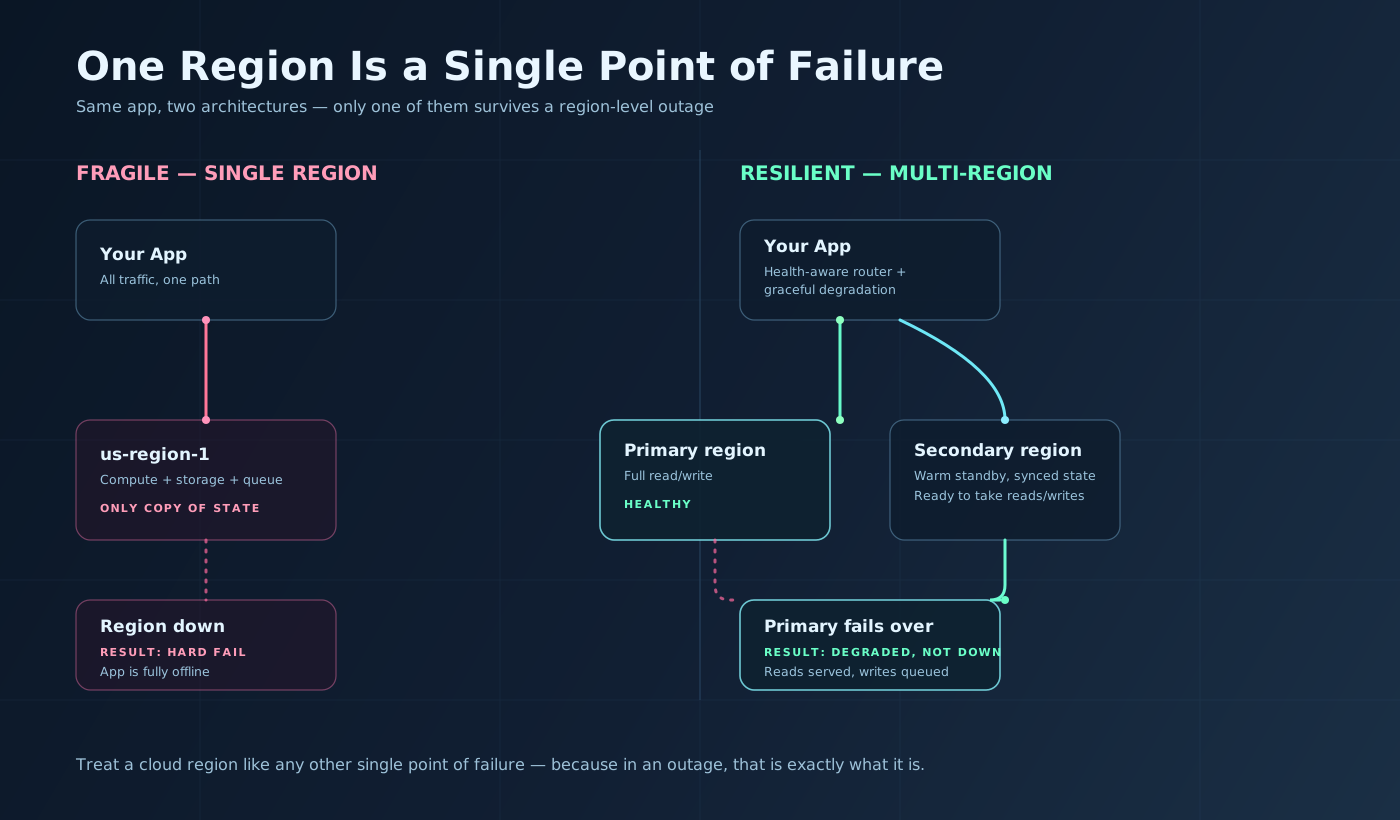 Same application, two architectures — only one of them survives losing a region.
None of these patterns are new — multi-region failover and graceful degradation have been reliability-engineering staples for over a decade. What's new is the urgency: infrastructure is being pushed harder, by newer capacity, under more time pressure than at any point in the cloud era. What was "nice to have" for a lot of teams is quietly becoming "should have had this already."
To be clear about what this post is and isn't claiming: Forrester's prediction is a prediction, not a confirmed event with a date on the calendar. It could turn out too pessimistic, or it could be an undercount — infrastructure forecasts are inherently uncertain, since they depend on operational decisions inside companies that don't publish internal reliability data. What isn't uncertain is the mechanism: AI workloads strain infrastructure differently, capacity is being built faster than operational maturity typically allows, and 2025's outages plus 2026's smaller incidents are consistent with that strain showing up operationally. Whether or not 2026 produces the exact event Forrester is calling, the conditions that would produce it are real and worth designing around.
Key Takeaways
- Forrester predicts AI data-center capacity upgrades will cause at least two major multi-day cloud outages in 2026 — treat this as a risk signal to plan around, not a confirmed event.
- AI workloads strain infrastructure differently than typical web traffic: lumpy power and cooling demand, newer and less battle-tested hardware, and operational playbooks that haven't caught up to the pace of build-out.
- 2025's AWS and Azure outages, plus 2026's Google Cloud latency issues in India and the AWS me-central-1 regional outage, are smaller-scale signals consistent with the pattern, not proof of the prediction itself.
- Global data-center spend exceeding $650 billion in 2026 (a 31.7% jump) is the scale of build-out creating this operational risk — fast growth and operational maturity are usually in tension.
- Multi-region failover and graceful degradation are the two patterns that actually reduce your exposure, regardless of whether the predicted outage happens this year.
- Treat a cloud region exactly like you'd treat any other single point of failure — and test your failover path before an actual outage forces you to find out it doesn't work.
Related Posts
- Agent Reliability Blueprint: SLOs, Guardrails, and Human Override — The same resilience-engineering mindset — SLOs, circuit breakers, graceful degradation — applied to production agent systems rather than infrastructure.
- Terraform + MCP + AI Agents: The New Infrastructure Stack Nobody's Talking About — Infra-as-code patterns relevant to building and auditing multi-region resilience.
- MLOps Is Just DevOps With More Humility — The operational discipline this post argues for, applied to AI infrastructure and model behavior more broadly.
- Cloud 3.0: Sovereign Cloud, Explained — The architectural shift toward multi-cloud and sovereign regions that's partly a response to this same risk.
- Where the Record 2026 Data Center Spending Is Actually Going — Where the record data-center spend driving this capacity crunch is actually being deployed.
Running production systems on a single cloud region right now? Worth spending an afternoon mapping what actually breaks if it goes dark. Tell me what you find in the comments.