I pulled DeepSeek-R1 locally on a weekend, mostly out of curiosity. Within an hour I had stopped being curious and started being unsettled.
Not because it was perfect. Because it was good enough — running on my laptop, quantized, on a model that cost approximately $6M to train — to make me question the premise behind almost every infrastructure decision I had watched large AI labs justify over the previous two years.
The Explanation That Silicon Valley Reached For
When DeepSeek-R1 dropped and the benchmark numbers landed, the immediate response from the US AI industry followed a predictable arc. The model distilled from OpenAI's outputs. Export controls kept them hungry, which forced creativity. It won't generalize. The quality won't hold. Wait for the next GPT.
All of those explanations may contain some truth. None of them are the whole story. And none of them address the one fact that doesn't go away regardless of how DeepSeek got there: they got there.
The training cost differential is not a rounding error.
| Model | Est. Training Cost | MMLU / Coding Benchmark Range | Open Weights |
|---|---|---|---|
| GPT-4 | ~$100M | 86–90% | No |
| Claude 3 Opus | ~$50–80M est. | 84–88% | No |
| DeepSeek-R1 | ~$6M | 84–90% | Yes |
A 15–17x cost gap at comparable benchmark performance is not a footnote. It is a structural fact about the efficiency frontier of language model training — and who currently sits on the right side of it.
The Moat That Was Not a Moat
The implicit bet of the US AI industry for the past three years has been a hardware moat. Compute access, NVIDIA allocations, data center buildout, H100 clusters — these were supposed to be the compounding advantages that made the incumbent labs unassailable. Export controls would slow Chinese labs further. The capital flywheel would widen the gap.
DeepSeek did not close the gap by getting more compute. It closed the gap by needing less.
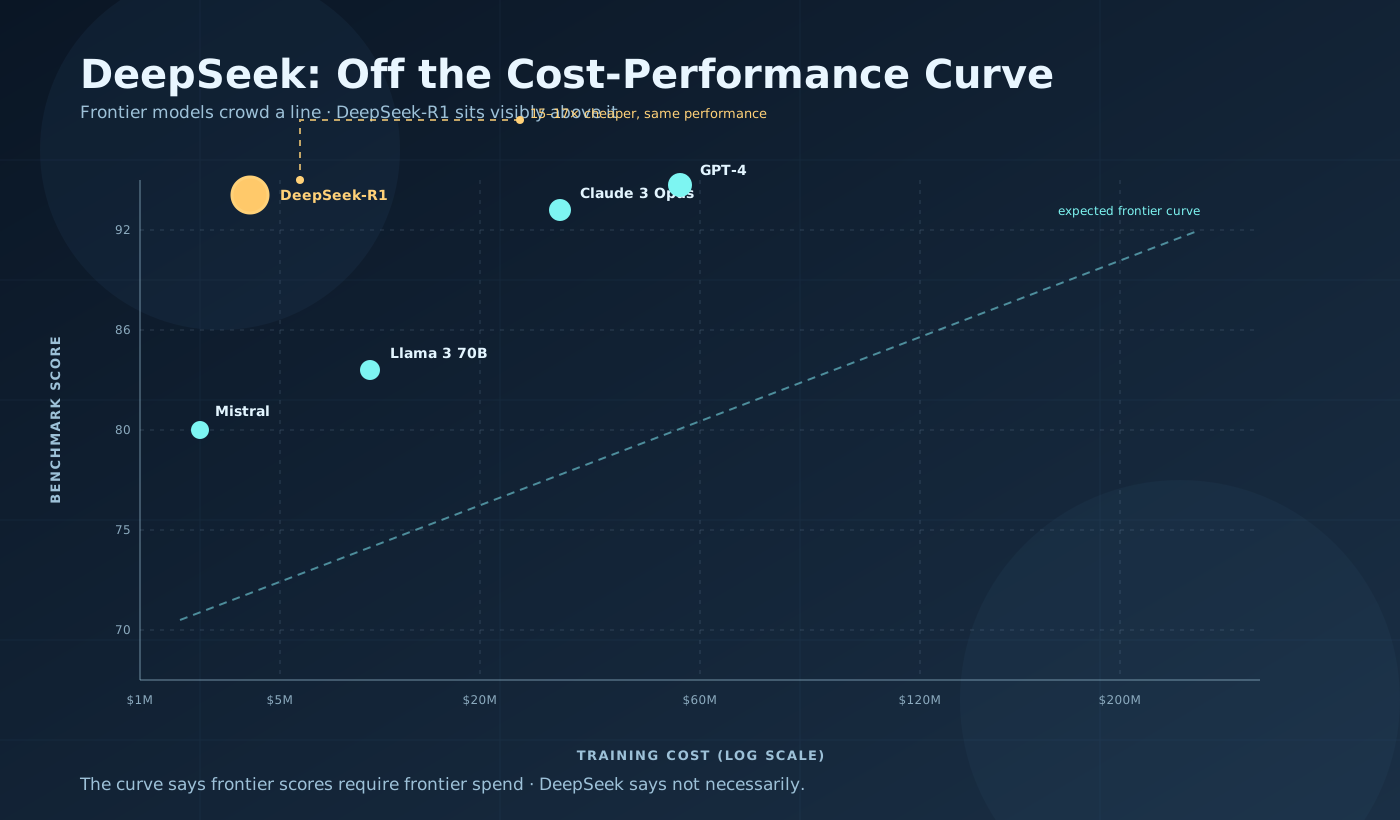 DeepSeek-R1 sits visibly off the expected cost-performance curve. Every other point roughly follows the trend. This one doesn't.
That distinction matters because hardware advantages diffuse slowly. Algorithmic advantages diffuse immediately — especially when the model weights are public and the paper describing the training methodology is available on arXiv.
The architectural innovations in DeepSeek-R1 — mixture-of-experts routing, aggressive KV cache management, the reinforcement learning approach to reasoning — are now readable, reproducible, and being absorbed into every serious lab's training roadmap. The efficiency gap that took constrained resources to discover is now part of the shared knowledge base of the field.
What This Means for How You Build
Running it locally takes two commands:
ollama pull deepseek-r1:7b
ollama run deepseek-r1:7b
That is the access equation changing in real time. A $6M training run that you can serve on a consumer laptop shifts something fundamental about who gets to run inference, where, and at what cost. This is the same dynamic covered in Stop Fine-Tuning GPT-5 from the domain adaptation angle — but DeepSeek extends it upstream: the base model itself is now competitive, open, and cheap to serve.
For production inference, the local API call looks like this:
import ollama

response = ollama.chat(
    model="deepseek-r1:7b",
    messages=[{"role": "user", "content": prompt}],
)
print(response["message"]["content"])
No API key. No per-token billing. No data leaving your infrastructure. For a certain class of workloads — internal tooling, regulated industries, latency-sensitive pipelines — that is not a convenience. It is a requirement that just became achievable without a $200K GPU cluster.
The Uncomfortable Conclusion
I am skeptical of the "China is winning AI" narrative. I am equally skeptical of "nothing to see here." Both framings are geopolitical and both of them miss the actual engineering story.
The engineering story is this: the dominant strategy of the US AI industry — scale compute, widen the hardware gap, let the capital moat do the work — turned out to be solving a problem that was not as hard as it looked. DeepSeek found a more efficient path not because they are smarter, but because they had no choice but to look for one.
The benchmarks in 2026 are still worth reading critically, as laid out in AI Benchmarks 2026. And the broader question of what AI is actually delivering — beyond benchmark theater — is the right frame for any infrastructure decision, as the Skeptic's Reality Check covers in full.
But none of that changes the core fact sitting under this whole conversation: the efficiency of frontier model training just got demonstrated to be more compressible than the industry's capex strategy assumed. That assumption was load-bearing. And it turned out to be wrong.
That's worth sitting with, even if there's no clean geopolitical narrative to hang it on.
Related Posts