Fable 5 Is Back: What a 19-Day Government Shutdown Taught Us About AI Infrastructure Risk
On June 12, 2026, Fable 5 stopped existing for its users. Not because Anthropic pulled it, and not because a data center lost power. The U.S. Department of Commerce imposed export controls on the model, and one of the most capable systems on the market became legally off-limits overnight — described at the time as the most disruptive government-ordered AI model restriction in history.
It came back on July 1, at 3:31pm ET, after 19 days offline. Commerce lifted the controls on June 30, and access was restored worldwide the next day, across Claude.ai, the Claude Platform API, Claude Code, and Claude Cowork, in every country Fable 5 had ever shipped to.
That's the news. It's a short story, and it has a clean ending. But if you build anything that depends on a single model from a single provider, the interesting part isn't that Fable 5 came back — it's what those 19 days reveal about a failure mode your incident runbook probably doesn't cover.
What Actually Happened
Stripped of commentary, the timeline is simple:
- June 12, 2026 — Commerce imposes export controls on Fable 5. Access is suspended for all users, worldwide, with no advance warning.
- June 12 – June 30, 2026 — 19 days of suspension. No workaround, no regional exemption, no tier that kept working.
- June 30, 2026 — Commerce lifts the export controls.
- July 1, 2026, 3:31pm ET — Access is restored everywhere at once: Claude.ai, the Claude Platform API, Claude Code, and Claude Cowork.
The timing isn't happening in a vacuum, either. This resolved just weeks before voluntary AI model safety standards take effect on August 1, 2026 — a deadline that puts government involvement in frontier model operation squarely on the calendar, not just in the news cycle. It's also playing out against a backdrop of enormous capital concentrated on the assumption that access to labs like Anthropic keeps working: Menlo Ventures built one of the largest single-bet venture funds in the industry almost entirely on confidence in Anthropic's trajectory. When a regulator can flip that access off for nearly three weeks with a memo, that confidence has a variable in it no pitch deck accounts for.
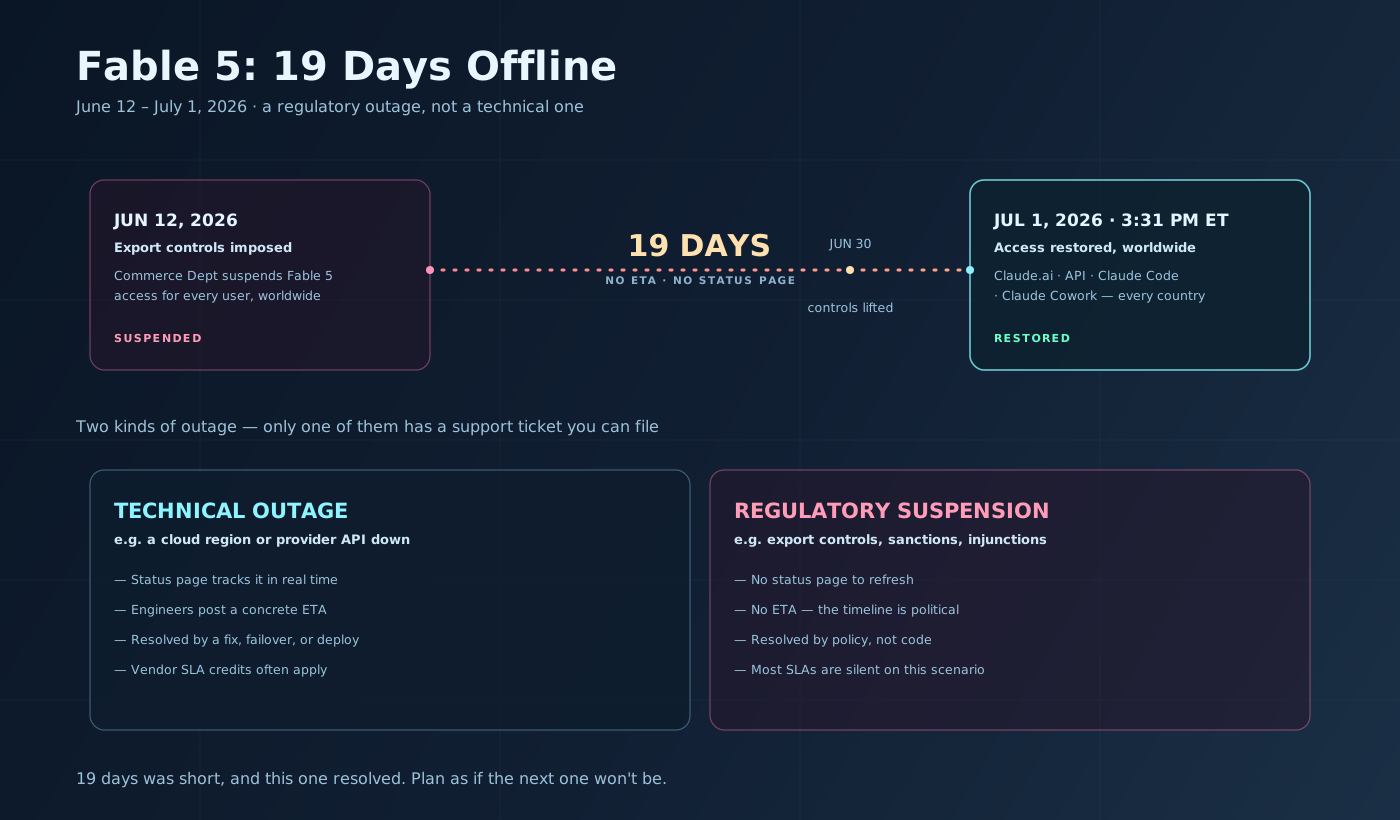 A regulatory suspension runs on a different clock than an outage — and nobody posts updates to it every 15 minutes.
Why This Is a Different Risk Category Than an Outage
Every engineer who has been paged at 3am has a mental model for "the provider is down": check the status page, read the incident report with its ETA, wait for the fix or failover, read the postmortem.
An export-control suspension doesn't behave like that, and treating it as "a longer outage" means planning for the wrong thing:
- No status page. The information you need is in government filings and press releases, not an engineering incident channel.
- No ETA. A regulator generally won't commit to a timeline, because the resolution isn't a technical fix — it's a decision made on a political and legal clock.
- Nothing for your team to fix. Outages get resolved by people who report to your vendor's VP of Engineering. Suspensions get resolved by trade negotiations, agency reviews, or litigation your vendor doesn't fully control either.
- Contracts rarely cover it cleanly. Most SLAs promise credits for infrastructure failures, not for a government order cutting you off. Read yours before you assume you're covered.
- It can be total, not partial. A regional outage usually leaves you a failover region. An export-control order can be global and absolute, with no tier that still works.
None of this means the suspension was mishandled by anyone involved. It means the risk category is genuinely different, and a runbook written for "AWS us-east-1 is down" won't help when the actual answer is "check back after the interagency review."
What This Actually Means If You're Building on a Single Model
You don't need to overreact to a 19-day event that already resolved. You do need to add it to the list of things your architecture accounts for, the same way you already plan for a cloud region going dark:
- Keep a real fallback provider wired up, not just documented. "We could switch models if we had to" isn't the same as an abstraction layer that already routes to a second provider with tested prompts and evaluated output quality. Exercise that path before you need it.
- Avoid provider-specific lock-in in your prompts and tooling. If your tool-calling schemas and prompt structure only work against one vendor's API shape, your "fallback" is actually a multi-week migration disguised as a config change.
- Design for graceful degradation, not just failover. A cheaper or older model that keeps your product limping along beats a hard outage. Decide in advance which features can run on a lesser model and which should just queue or disable themselves.
- Read the regulatory exposure into your compliance posture, not just your infrastructure diagram. Ask what jurisdiction your inference actually runs in and what happens contractually if a government order suspends it — the same sovereignty question we've written about before, applying just as much to sudden suspension as to data residency.
- Push for contract language that acknowledges this scenario. Force majeure and uptime SLAs were written with data centers in mind. Ask your vendor directly what a government-ordered suspension does to your contract, credits, and support.
Keep the Scale Honest
It's worth saying plainly: 19 days is short, and this case resolved cleanly with no lasting restriction. This isn't a doom post — Fable 5 is back, fully, everywhere, no asterisk needed. The point isn't that this specific incident should keep you up at night. It's that "a government can suspend access to the model my product depends on, with days of notice and no ETA" is now a demonstrated failure mode, not a hypothetical one. A risk doesn't need to repeat often to earn a line on your risk register — it needs to have happened once, credibly.
Separately, and on a much smaller scale: July 1, 2026 was also the day Claude Sonnet 5 became the default model for Free and Pro users — a routine swap that happened to land the same week Fable 5 came back online. Covered in detail in Claude Sonnet 5 Becomes the Default Model: Should You Switch?
Key Takeaways
- Commerce imposed export controls on Anthropic's Fable 5 on June 12, 2026, suspending it worldwide; controls were lifted June 30, and access returned everywhere on July 1 at 3:31pm ET — 19 days total.
- Called the most disruptive government-ordered AI model restriction to date, it lands weeks before voluntary AI model standards take effect on August 1, 2026 — regulatory involvement in model availability is now recurring, not a one-off.
- Regulatory suspensions are a distinct risk category from technical outages: no status page, no ETA, no engineering fix, and a resolution timeline set by policy rather than code.
- Concentrated capital bets on single AI labs (like Menlo Ventures' Anthropic-heavy fund) make this a portfolio-level risk, not just an engineering one.
- If you depend on a single model or provider in production: build and actually test a fallback path, avoid vendor-specific lock-in, design graceful degradation, and check what your contract says about government-ordered suspension.
- Be proportionate: 19 days was short and this resolved cleanly. The lesson is "plan for this risk category," not "panic about this specific event."
Related Posts
- AI Security & Sovereignty: The Gap Nobody Has Actually Closed — The broader regulatory landscape this suspension is part of, including the August 2026 compliance deadlines shaping AI infrastructure decisions.
- Agent Reliability Blueprint: SLOs, Guardrails, and Human Override — How to design production AI systems with the failover and graceful-degradation patterns this post argues for.
- Two Leaks in Five Days: What Anthropic's Worst Week Tells Us About AI Lab OpSec — Another case study in the operational risks of building on a frontier AI lab's stack.
- Why Would I Choose Claude Code? — Practical context on the Claude Code product mentioned above, for readers evaluating a broader Anthropic dependency.
- Claude Sonnet 5 Becomes the Default Model: Should You Switch? — What changed when Sonnet 5 became the default model, days after this suspension ended.