Claude Sonnet 5 Is Now the Default Claude Model — Should You Switch?
Until this week, opening a new Claude chat meant a tiny decision you probably didn't think much about: which model. Sonnet, Opus, Haiku — whichever one happened to be selected last time, or whichever one you vaguely remembered was "the good one." Starting July 1, 2026, that decision got made for you. Sonnet 5 is now the default model for every Claude Free and Pro user.
"Default" is doing a lot of work in that sentence. It does not mean Sonnet 5 is the best Claude model at everything — Opus 4.8 still exists, still costs more, and still wins on the hardest tasks. It means Anthropic decided that for most of what people actually do with Claude, Sonnet 5 is the best trade-off between quality, speed, and cost, and made that trade-off the thing you get without having to ask for it.
Here's the practical version of that story: what changed on July 1, what Sonnet 5 is good at now that it's carrying the default-model load, and the honest list of situations where it's still worth the extra click to switch to Opus 4.8 yourself.
What Actually Changed on July 1
- Free plan users get Sonnet 5 by default, at no cost, subject to the free plan's usage limits.
- Pro plan users ($17/month) also default to Sonnet 5, but with meaningfully higher usage limits — longer sessions, more requests before you hit a ceiling.
- Manual selection didn't go away. Pro users can still open the model picker and choose Opus 4.8 for a specific conversation when they want maximum accuracy over speed or cost. It just isn't the default anymore — you reach for it on purpose.
- The models themselves didn't change. This is a default-routing change, not a capability change. Sonnet 5 didn't get smarter on July 1; it started being the model most people talk to without asking for it by name.
Practically: open a new conversation, and it's already on Sonnet 5, no picker required.
What Sonnet 5 Is Actually Good at as the Default
Default models get judged on breadth across everyday workloads, not peak performance on a narrow set of hard benchmarks. Sonnet 5 earns the slot on exactly that basis:
- Everyday coding — writing functions, fixing bugs, working through a stack trace, reviewing a diff, explaining an unfamiliar file. This is the bulk of real developer usage, and it's squarely Sonnet 5's strike zone.
- Iterative work — the back-and-forth "no, more like this" refinement that makes up most real conversations. Sonnet 5 is fast enough that the loop doesn't feel like waiting on the model.
- General reasoning and writing — summarizing documents, drafting emails, explaining a concept, thinking through a decision. None of this needs Opus-level depth to be handled well.
- Cost-sensitive, high-volume use — if you're calling Claude through the API at real volume, Sonnet 5 being the default keeps your baseline spend sane without manually routing every call.
Same logic as Stop Fine-Tuning GPT-5: A 7B Model Will Beat It on Your Use Case and Small Models, Big Impact: match model capability to what the task needs, not to habit.
When It's Still Worth Manually Switching to Opus 4.8
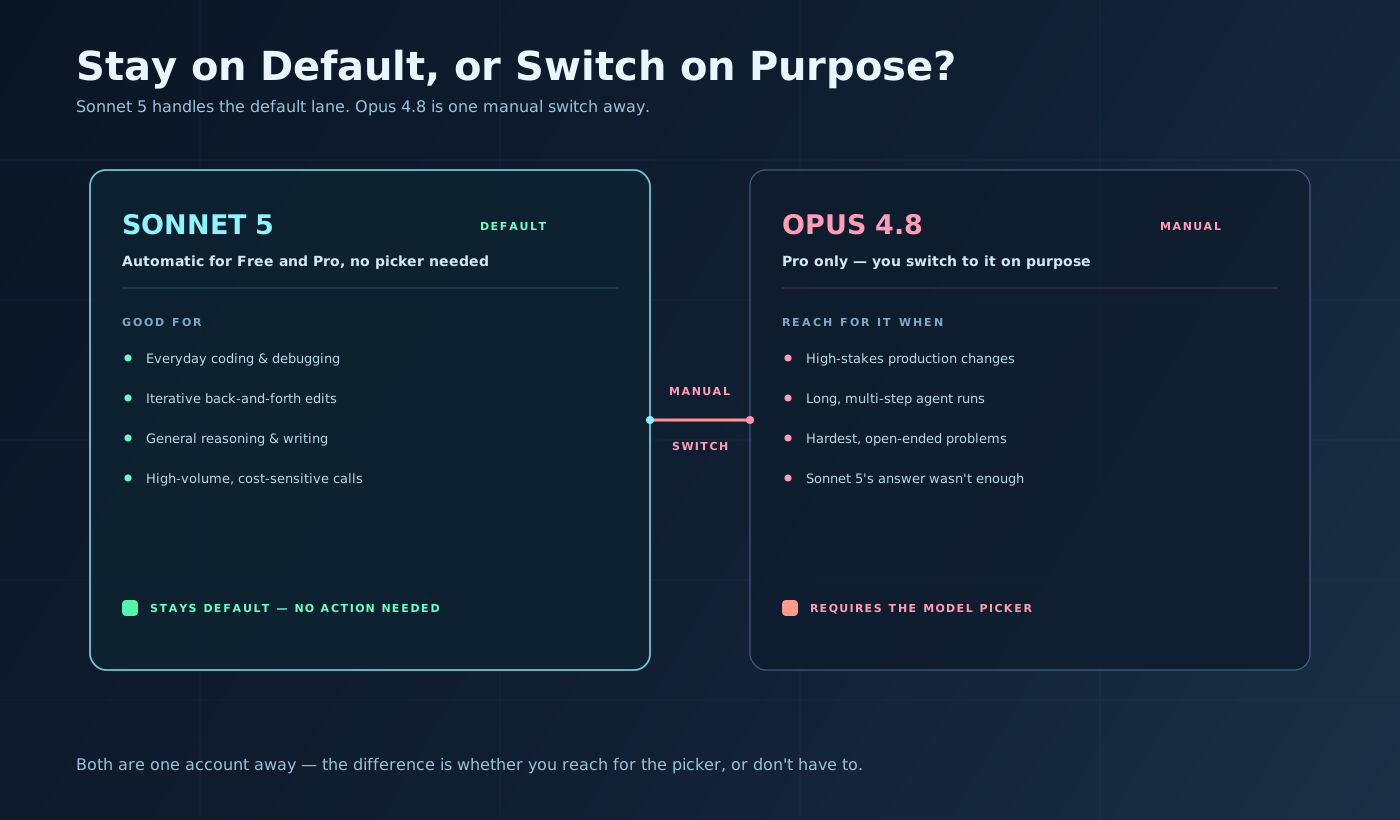 Sonnet 5 covers the default lane. Opus 4.8 is a deliberate choice for the harder edge of the distribution.
Sonnet 5 being the default doesn't mean Opus 4.8 got demoted — it means Opus 4.8 became something you reach for on purpose instead of remembering to pick it every time. A few concrete situations where that manual switch earns its cost:
- Maximum-accuracy, high-stakes changes — a production database migration, a security-sensitive auth rewrite, a legal or financial document where a subtle error is expensive. When the cost of being wrong outweighs the cost of the pricier model, pay for the headroom.
- Long, multi-step agentic runs — the longer an autonomous task runs, the more small reasoning errors can compound into a wrong final answer. Opus 4.8's extra reasoning depth pays for itself over a long horizon in a way it might not on a single quick question.
- Genuinely hard, open-ended problems — architecture decisions with real trade-offs, a bug that's resisted three other attempts, anything where you want the model to sit with the problem longer rather than answer faster.
- When Sonnet 5 already tried and it wasn't enough — start on Sonnet 5, since you're already there, and escalate to Opus 4.8 only if the output doesn't hold up. That's cheaper than defaulting to the expensive model for tasks that never needed it.
Be honest about the trade: Opus 4.8 isn't "better" on every axis. It costs more and answers more slowly. Switching to it for a two-line bug fix is paying flagship prices for workhorse work.
Free vs. Pro: What You Actually Get
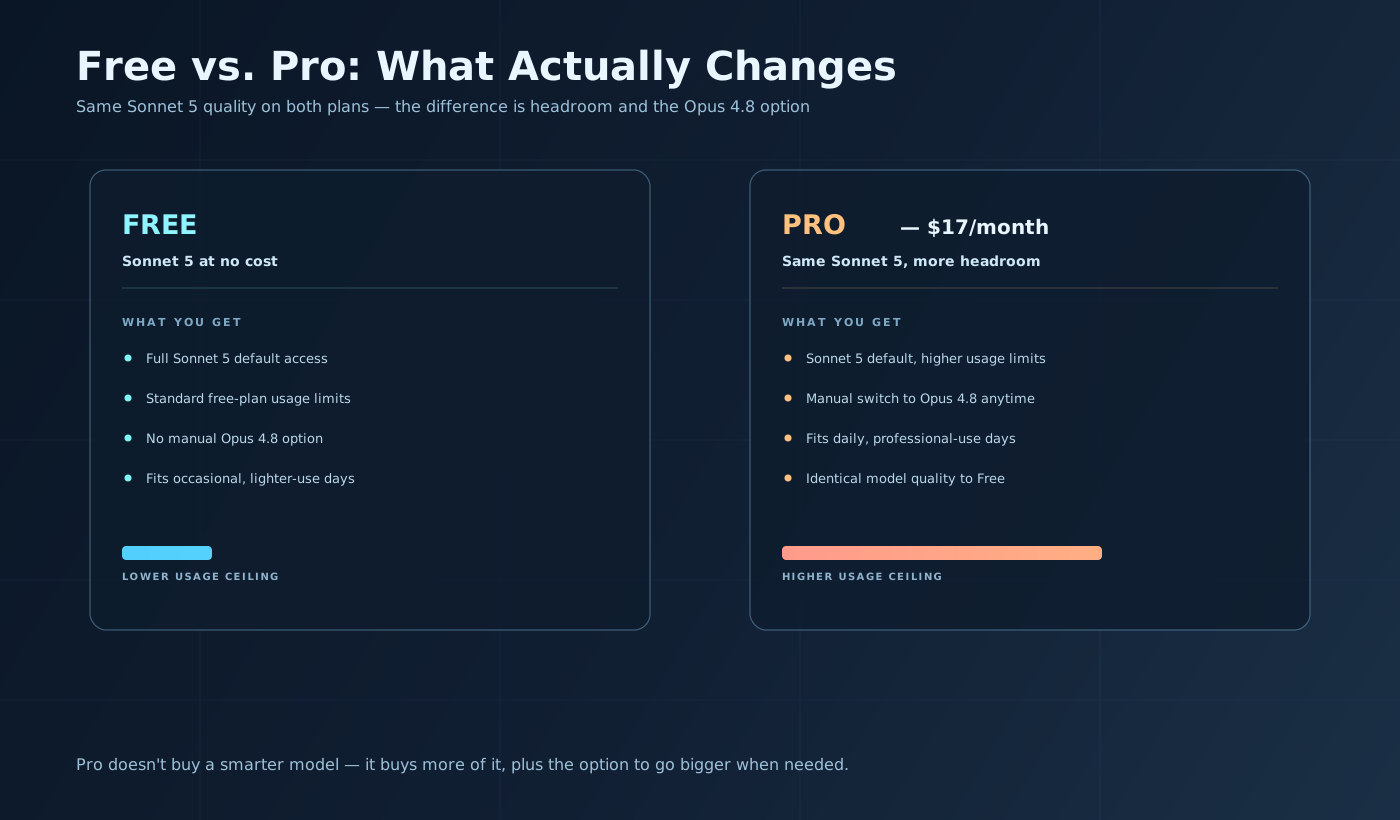 Pro doesn't change what Sonnet 5 can do — it changes how much of it you get, and whether Opus 4.8 is one click away.
- Free plan — Sonnet 5 access at no cost, governed by the free plan's usage limits. Good for occasional use and lighter day-to-day questions.
- Pro plan ($17/month) — the same Sonnet 5 default, but with higher usage limits, plus the ability to manually select Opus 4.8 when a task calls for it.
- Neither plan changes what Sonnet 5 can do. Model quality is identical on both. Pro buys headroom — how much you can use before hitting a limit — and optionality, the ability to reach for Opus 4.8 on demand.
- If you're on Free and hitting limits regularly, that's the real signal to consider Pro — not model quality, but how often you're getting throttled.
The Timing Wasn't a Coincidence
Sonnet 5 becoming the default landed at an interesting moment for Anthropic's lineup. Days earlier, Fable 5 — one of Anthropic's other models — came back online after a 19-day government-ordered export-control suspension, offline from June 12 through July 1, 2026. That's a separate story, covered in full at Fable 5 Returns After a 19-Day Government-Ordered Suspension.
For this post, the relevant fact is just the current shape of the family: Fable 5, Opus 4.8, Sonnet 5, and Haiku 4.5, with Sonnet 5 now sitting in the default, flagship-for-most-people slot that used to require a manual pick.
Key Takeaways
- Since July 1, 2026, Sonnet 5 is the default model for both Claude Free and Pro users — no manual selection required.
- Free users get Sonnet 5 at no cost under free-plan usage limits; Pro users ($17/month) get the same model with higher limits.
- Pro users can still manually select Opus 4.8 per conversation — that option didn't disappear, it just stopped being automatic.
- Sonnet 5 as default suits everyday coding, iterative back-and-forth, general reasoning and writing, and cost-sensitive high-volume use.
- Reach for Opus 4.8 when the task is high-stakes, long-horizon/agentic, or genuinely hard — when a wrong answer costs more than the pricier model does.
- "Default" means best trade-off for most people, most of the time — not best model for everything. The picker is still there, just optional now.
Related Posts
- GPT-5.6's Three Tiers: Sol, Terra, and Luna, Simply Explained — the same "which tier should I actually use" question, asked about OpenAI's lineup.
- Fable 5 Returns After a 19-Day Government-Ordered Suspension — what happened days before this rollout, when Fable 5 returned from a government-ordered suspension.
- Why Would I Choose Claude Code? — how Claude's models show up in practice inside Anthropic's agentic coding tool.
- The State of AI Benchmarks in 2026 — how to read model benchmark claims, like the ones used to justify a "flagship" label, without being misled by them.
- Stop Fine-Tuning GPT-5: A 7B Open-Source Model Will Beat It on Your Use Case — the broader case for matching model capability to task difficulty instead of defaulting to the biggest option.