Bounded Agents: The Only Multi-Agent Pattern That Actually Works in Production
Picture a new hire on their first day. Would you hand them the keys to every system and check back in a week? No. You'd give them one task, check their work, and expand their scope slowly, as they earned it. So why do we keep trying the opposite with AI agents?
For two years, the industry dream has been the "virtual employee" — one agent, one prompt, and it handles everything. Books the trip, files the report, closes the ticket, ships the code. Autonomous end to end. It's a great demo. It is a bad way to run a business.
The teams actually getting value out of agents in 2026 are doing something much less exciting. They run many small agents, each with one narrow job, each watched by a human who can pull the plug. Not flashy. It works. Here's why.
Quick Definitions, So Nothing Here Is Jargon
Before anything else, three terms this post leans on:
- Agent — an AI system that doesn't just answer a question once. It takes an action, looks at the result, and decides what to do next, in a loop, without a person typing every step.
- Bounded agent — an agent with a small, fixed job description. "Summarize this ticket." Not "handle customer support."
- Orchestration — the layer that decides which agent runs when, passes work between them, and stitches the results together. Think of it as the project manager, except the project manager is code (or a human).
Keep those three in your head. Everything below is just consequences of them.
What Actually Changed in 2026
Two years ago, an "AI agent" was really just a chatbot with a slightly longer memory. You asked a question, it answered, done in seconds. That's not what runs in production now. Agents today run for minutes or hours at a stretch, calling tools, reading the results, and calling more tools, without a person typing every step. That's a real capability jump — and it's also where things get dangerous, because a mistake made early in an hour-long loop doesn't just sit there. It gets built on.
Adoption reflects the shift. Gartner expects 40% of enterprise applications to use task-specific AI agents by the end of 2026, up from under 5% a year earlier. That's a real curve, not hype. But adoption and success are two different charts, and the gap between them is this post.
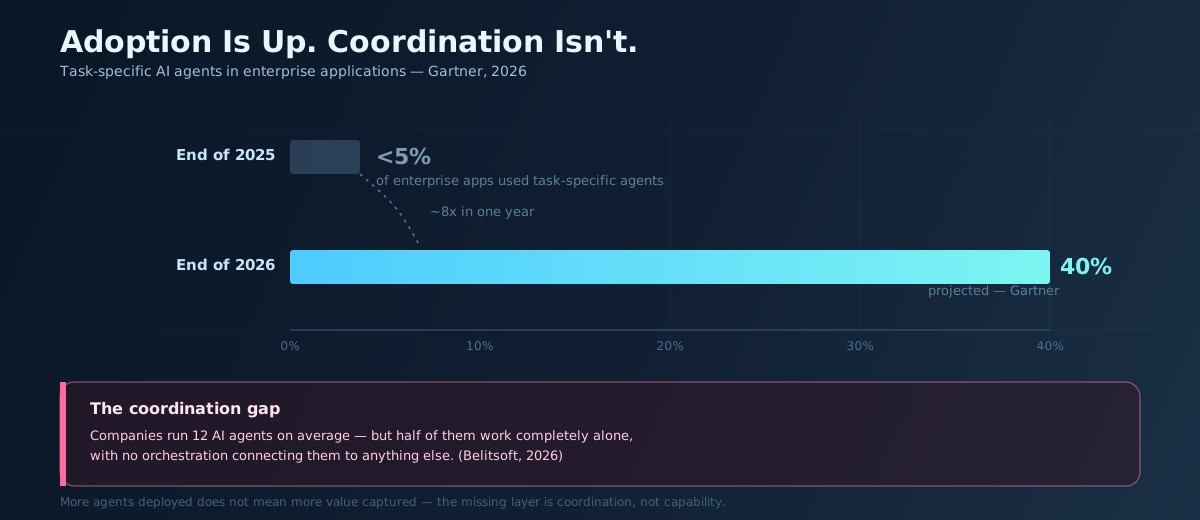 Adoption climbed roughly 8x in a year. The coordination layer didn't climb with it.
The Coordination Gap Nobody Talks About
Here's a number worth sitting with: a 2026 industry survey (Belitsoft) found that companies run 12 AI agents on average — but half of those agents work completely alone. No handoffs, no shared context, no orchestration layer connecting them to anything else.
That means you don't have a team of 12. You have 12 solo contractors who've never met, each doing their own thing, with nobody making sure the output of one doesn't quietly break the input of another. That's not a tooling gap — it's a management gap. And it's exactly the gap the "one giant agent" dream tries to paper over, by having a single agent do everything itself so there's nothing left to coordinate. Except now all the risk lives inside one enormous, hard-to-inspect loop instead of being spread across smaller, checkable pieces.
Why the Giant Autonomous Agent Fails
Three reasons, and none of them are exotic.
1. Errors Compound
An LLM (the model behind an agent — the part that decides what to do next) is right most of the time, not all of the time. One step with a small error rate is fine. Fifty chained steps are not — each wrong step gets trusted by every step after it. A bounded agent gives an error one place to happen and one obvious place to catch it. A giant agent spreads that same error across a chain nobody is watching in the middle of. By the time a human looks, the mistake is buried under twenty steps that all built on it.
2. Nobody Can Audit a Black Box
If an agent takes one well-defined action, you can check the input and output and know in five seconds whether it did the job. If it runs autonomously for three hours, picking its own sub-goals as it goes, reconstructing "why did it do that" afterward is close to impossible — there's no clean seam to inspect.
That's not hypothetical anymore; it's where the money is going. The mood shifted hard in 2026: less "look what my agent did," more "prove what my agent did was safe." Regulators, security teams, and buyers all want the same things — data provenance (where did this input come from), explainable outputs (why did it produce this), and documented tools (what exactly is running). Enforceable systems, not policy PDFs nobody reads. You cannot build that out of one opaque agent. You can build it out of ten small ones, each logging what it did and why.
3. Trust Has to Be Earned in Small Pieces
Would you trust a brand-new employee with the company bank account on day one? Trust is built by watching someone succeed at small things first, then widening their scope. A bounded agent that nails a narrow task for months earns wider access. A giant agent that's never been checked at any single step hasn't earned anything — it's just been assumed fine.
The Pattern That Works: Many Small Agents, One Human Loop
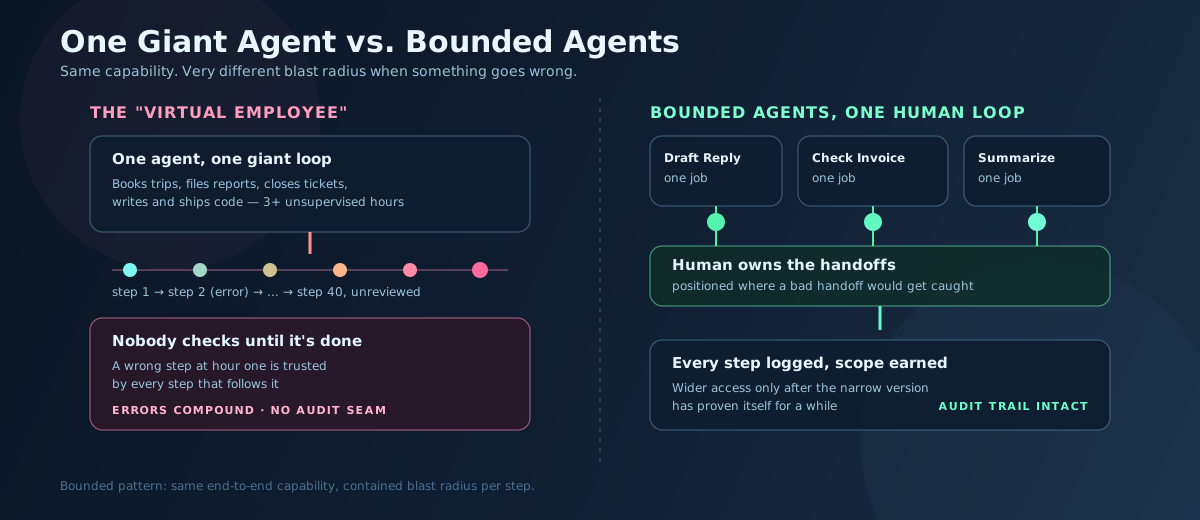 Same end-to-end capability. Very different blast radius when a step goes wrong.
Here's what it actually looks like in the shops getting this right:
- Break the workflow into small, specific jobs — "draft the reply," "check the invoice against the PO," not "run the department."
- Give each bounded agent a narrow set of tools and a clear definition of done.
- Put a human at the checkpoints between agents — positioned where a bad handoff would actually get caught, not glancing over everything after the fact.
- Log every step, so when something goes wrong you can point at the exact agent and the exact action.
- Only widen an agent's scope after it's proven itself in the narrow version for a while.
Notice what's missing: no single agent planning its own multi-hour mission with no check-ins, no "just trust the model." The human isn't babysitting the model line by line — the human owns the loop between agents, the same way a manager owns handoffs between employees rather than watching every keystroke. This is the same shape I described in the Agent Reliability Blueprint — SLOs (a measurable bar for "good enough"), circuit breakers that stop a bad loop before it spreads, escalation ladders back to a person. Those aren't add-ons bolted onto a big autonomous agent after launch; they're what a bounded architecture gives you for free, because the boundaries are already there to attach guardrails to. It's the same pattern behind the repo-level coding agents that actually work well: narrow specialists — find the dependency, propose the diff, run the tests — wired together, with a developer approving the risky steps.
Pro tip: Before you write the prompt, write down the failure mode. What happens if this agent is wrong? If the honest answer is "nobody would notice for hours," you've found the boundary you're missing — split the task, or add a checkpoint, before you build anything.
"Boring" Is a Compliment Now
A year ago, the exciting agent story was the one that did the most on its own. Today, the exciting agent story is the boring one — predictable, checkable, doesn't surprise you at 2am. That's not lower ambition. It's what "production-ready" has always meant, in every field, before AI showed up.
It's also why AI governance is moving from "we have a policy document" to "we have systems that enforce the policy automatically." A policy is a promise. A bounded, logged, checkpointed agent architecture makes that promise hard to break by accident — the same lesson I wrote about in MLOps being DevOps with more humility: the discipline that feels like it's slowing you down is usually what stands between you and a very bad Tuesday.
Key Takeaways
- Agents in 2026 run for minutes or hours as autonomous loops — a mistake made early gets built on by everything that follows it.
- Gartner expects 40% of enterprise apps to use task-specific agents by end of 2026, up from under 5%. Adoption isn't the same as getting value.
- The average company runs 12 agents, and half work in isolation with no orchestration. The coordination layer, not the model, is the bottleneck.
- The giant "virtual employee" agent fails for three reasons: errors compound over long chains, nobody can audit a black box, and trust can't be handed out all at once.
- What works: many small, narrow-scoped agents, clear checkpoints, full logging, and a human owning the handoffs between them — not watching every keystroke.
Related Posts
- Agent Reliability Blueprint: SLOs, Guardrails, and Human Override — The practical architecture bounded agents make possible.
- Repo-Level AI Agents: How Coding Assistants Learned to Reason Across a Whole Codebase — The same narrow-specialist pattern, applied to coding agents.
- Your AI Agent Just Got Fired: Why Agentic AI Still Can't Handle Real Business — What happens when these boundaries get skipped.
- MLOps Is Just DevOps With More Humility — The same "boring wins" lesson, from the ops side.
- Building a Production LLM Pipeline in 2025 — Eval loops and cost control that pair naturally with a bounded design.