Multimodal AI Is Finally Real: Building Apps That See, Hear, and Act
Here is the shape of the problem.
A finance team processes 200 vendor invoices a week. Half of them arrive as JPEGs or scanned PDFs. A quarter of those have line items a human needs to correct after the fact — usually via a quick voice note left for the bookkeeper. Then someone manually keys the corrected data into QuickBooks.
Three steps. Three different systems. Three places to drop data on the floor.
The old approach treats vision, voice, and action as separate pipelines: OCR the image, transcribe the audio, write glue code to reconcile them. What I want to show is that this is the wrong model. When you hand all three modalities to the same context, the seam disappears.
Step 1: The App Sees the Receipt
I start with a single API call. The receipt image is base64-encoded and passed alongside a structured output schema. The model extracts vendor, date, total, and line items in one shot — no OCR pre-processing, no regex parsing.
import anthropic, base64, json
from pathlib import Path

client = anthropic.Anthropic()

def extract_receipt(image_path: str) -> dict:
    image_data = base64.standard_b64encode(
        Path(image_path).read_bytes()
    ).decode("utf-8")

    response = client.messages.create(
        model="claude-opus-4-5",
        max_tokens=1024,
        messages=[{
            "role": "user",
            "content": [
                {
                    "type": "image",
                    "source": {"type": "base64", "media_type": "image/jpeg", "data": image_data},
                },
                {
                    "type": "text",
                    "text": (
                        "Extract this receipt as JSON with keys: "
                        "vendor (str), date (ISO 8601), total_usd (float), "
                        "line_items (list of {description, qty, unit_price_usd}). "
                        "Return only valid JSON, no prose."
                    ),
                },
            ],
        }],
    )

    return json.loads(response.content[0].text)
The output is a clean Python dict. No intermediate steps, no brittle regex, no separate OCR service to maintain. The model handles handwritten totals, rotated images, and mixed currency symbols with the same call.
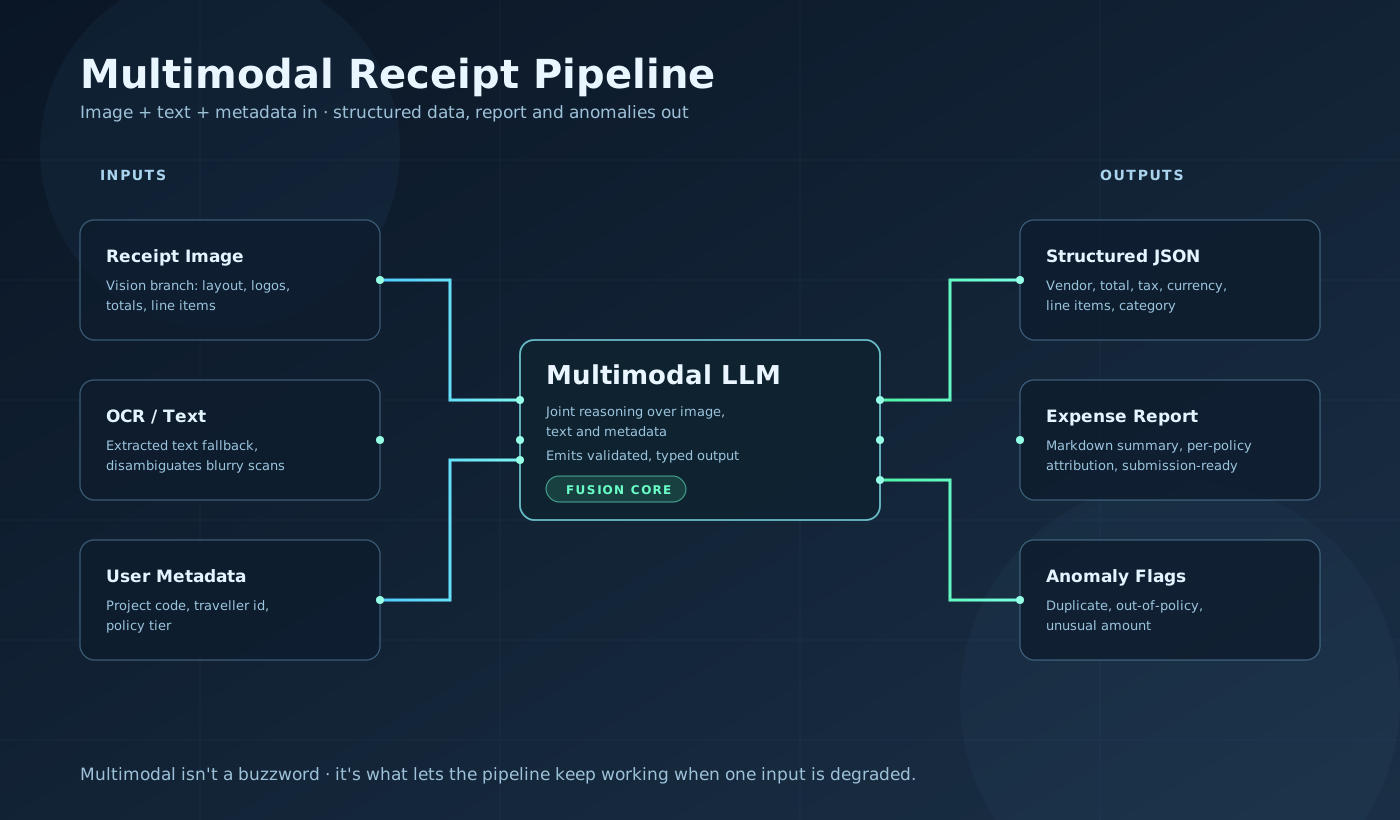 Three modalities, one context. The seam is gone.
The diagram above shows a single continuous band: [Receipt Image] flows into a Vision Model producing Structured JSON, which flows into an Audio Model that applies voice-memo patches, producing Patched JSON, which flows into a Tool Call that writes to the Accounting API. No handoffs. No separate state stores.
Step 2: The App Hears the Correction
The bookkeeper leaves a voice memo: "Line item three should be 4 units, not 2. And the vendor name is Acme Supply Co., not Acme."
I pass the extracted JSON from step 1 directly into the same model alongside the audio. The model patches in place — it does not re-extract from scratch, and I do not need a separate transcription step followed by another LLM call to apply the correction.
def apply_voice_correction(receipt: dict, audio_path: str) -> dict:
    audio_data = base64.standard_b64encode(
        Path(audio_path).read_bytes()
    ).decode("utf-8")

    response = client.messages.create(
        model="claude-opus-4-5",
        max_tokens=1024,
        messages=[{
            "role": "user",
            "content": [
                {
                    "type": "text",
                    "text": f"Current receipt data:\n{json.dumps(receipt, indent=2)}\n\n"
                            "The audio below contains corrections. Apply them and return "
                            "the updated receipt as valid JSON only.",
                },
                {
                    "type": "document",
                    "source": {"type": "base64", "media_type": "audio/mp4", "data": audio_data},
                },
            ],
        }],
    )

    return json.loads(response.content[0].text)
The key is that receipt — the output of step 1 — is already in the prompt context. The model sees both the visual extraction result and the audio correction at once. It resolves conflicts, applies partial updates, and returns a single clean object.
Step 3: The App Acts
The patched receipt goes to QuickBooks via a tool call. I define the tool schema once; the model decides when it has enough confidence to call it.
tools = [{
    "name": "create_bill",
    "description": "Create a vendor bill in QuickBooks from structured receipt data.",
    "input_schema": {
        "type": "object",
        "properties": {
            "vendor": {"type": "string"},
            "date": {"type": "string"},
            "total_usd": {"type": "number"},
            "line_items": {
                "type": "array",
                "items": {
                    "type": "object",
                    "properties": {
                        "description": {"type": "string"},
                        "qty": {"type": "number"},
                        "unit_price_usd": {"type": "number"},
                    },
                },
            },
        },
        "required": ["vendor", "date", "total_usd", "line_items"],
    },
}]
I pass patched_receipt and this tool definition in one more call. If something is missing — an ambiguous vendor name, a line item the model is uncertain about — it surfaces that rather than silently filling gaps.
The Actual Point
None of these three steps required a handoff to a separate system. Vision, audio, and tool use share a single context window. That is not an implementation detail — it is the thing that makes this pattern work at all.
In the old pipeline, the OCR output goes into a database. The voice transcription goes through a second NLP model. The reconciliation logic lives in application code that neither model can see. Every one of those transitions is a place where data loses fidelity and bugs hide.
The multimodal model is not doing three things. It is doing one thing — reasoning over inputs that happen to be in different formats — and that collapses the accidental complexity that three separate systems would introduce.
The honest scope: This pattern is production-ready for well-structured, predictable document types. Receipts, invoices, purchase orders. If your documents are deeply irregular or the audio corrections are high-variance, add a human-in-the-loop checkpoint before the tool call. See Building a Production LLM Pipeline for checkpoint patterns.
Key Takeaways
- Native multimodal models process image, audio, and context in one call — no OCR service, no separate ASR step
- Passing prior extraction results directly into the audio correction prompt is what eliminates the handoff; the model sees everything at once
- Tool call schemas serve as the contract between the LLM and your downstream system — define them tightly and let the model decide when it has enough signal to execute
- This pattern fails gracefully: if any modality returns uncertain output, add a confirmation step rather than silently propagating errors
Related Posts
- Multimodal AI Models: The Gap Is Closing Fast
- Agentic AI: The Next Big Shift
- Building a Production LLM Pipeline
- Agent Reliability Blueprint: SLOs, Guardrails, and Human Override
Built something on top of this pattern? Drop the architecture in the comments — especially if you have hit edge cases with audio quality or multi-page invoice images.